What Is a Debt Consolidation Loan? When It Makes Sense

By Tapabrata Biswas · Updated July 19, 2026 · 11 min read
Written and fact-checked by Tapabrata Biswas. How I write

A household carrying ₹2,40,000 across three credit cards at an average effective rate of 38% annualised pays roughly ₹91,000 in interest per year on minimums alone. The same balance moved to a personal loan at 14% APR over three years costs about ₹56,000 in total interest across the entire payoff. That gap is the economic case for debt consolidation, and it only exists when the new loan rate is actually lower than what was being paid.
A debt consolidation loan is one of the most misunderstood instruments in personal finance. The mechanics are mundane: borrow once, pay off several debts, repay the new loan on schedule. Consolidation does not reduce what is owed. It restructures it. The restructuring is worth doing only when the new structure costs measurably less or simplifies a payment situation that was causing missed payments.
What is a debt consolidation loan
A debt consolidation loan is a single new loan whose proceeds are used to pay off two or more existing debts. After the new loan funds, the borrower owes one lender, makes one monthly payment, and tracks one balance instead of several.
The new loan can take three main forms:
- An unsecured personal loan from a bank or NBFC, used to clear credit cards and other unsecured debts
- A balance transfer credit card, used to move existing card balances to a new card with a lower introductory rate
- A secured loan against an asset, a home equity loan in the US, or a gold loan in India, used at a lower rate than unsecured debt because the asset backs the loan
Consolidation is sometimes confused with debt settlement and debt management plans. They are different. Settlement negotiates with creditors to accept less than the full balance owed and damages the credit report for years. A debt management plan, run through a non-profit credit counselling agency, sets up structured repayment with reduced interest but does not involve a new loan. Consolidation simply replaces several debts with one new debt at hopefully better terms.
The three main types of debt consolidation
Each form has different eligibility rules, rates, and trade-offs.
1. Personal loan for debt consolidation
The most common form in both India and the US. An unsecured personal loan from a bank or NBFC funds in 1-7 days, and the proceeds clear the existing debts. The borrower then repays the personal loan in fixed monthly EMIs over 12 to 60 months.
Indian personal loan APRs run 10.5% to 24% depending on the borrower's CIBIL score and employment profile, per RBI's Database on Indian Economy (DBIE) sectoral lending data, 2024. A CIBIL score of 750+ unlocks the lower end of that range; scores below 700 cluster near the top.
US personal loan APRs span 7% to 36% based on credit profile, per the CFPB Consumer Credit Trends 2024 report. Origination fees of 1-8% of the loan amount are common in the US and effectively raise the borrower's true cost.
2. Balance transfer credit card
A balance transfer card moves existing credit card debt to a new card with a 0% or low introductory APR, typically for 12 to 21 months. After the introductory window expires, the rate jumps to the card's standard APR: usually 18-28% in the US.
This product is widely available in the US and rare in India. Most Indian banks offer balance-transfer features within their existing card products but seldom market 0% intro APR offers in the US style. The Indian functional equivalent for many borrowers is moving card balances onto a personal loan.
A balance transfer typically charges a fee of 3-5% of the transferred amount upfront. On a $5,000 transfer at 3%, that is $150 added to the balance on day one, meaningful but usually still cheaper than 12 months of credit card interest at 22%.
3. Secured loan: home equity (US) or gold loan (India)
When the borrower owns an asset, a secured loan against it carries a lower rate than unsecured debt because the lender's risk is reduced.
In the US, a home equity loan or HELOC against a paid-down home runs 8-10% per Federal Reserve H.15 data, late 2024: well below personal loan rates for most borrowers. The trade-off is that defaulting on a home equity loan puts the home at risk, converting unsecured credit card risk into secured housing risk.
In India, the gold loan is the closest equivalent. Banks like SBI, HDFC, and Muthoot offer gold loans at roughly 9-12% APR (NBFCs often higher). Funding is fast, same-day or next-day, and approval is based on the gold value, not the borrower's credit score. The risk is parallel: missed payments lead to the gold being auctioned.
When debt consolidation makes sense
Three conditions, in combination, make consolidation worth doing:
1. The new loan APR is meaningfully lower than the weighted-average APR of existing debts.
The threshold for "meaningful" depends on fees, but a rule of thumb: the new rate should be at least 4-6 percentage points below the weighted average to absorb origination costs and still leave net savings. A consolidation that drops the average from 22% to 19% may not pencil out after a 5% origination fee.
2. The borrower can afford the new monthly payment.
Personal loan EMIs are fixed and substantial: often higher than the sum of credit card minimums, because the personal loan is set up to actually retire the debt within a fixed term while card minimums never do. A consolidation loan that the borrower cannot afford ends in default.
3. The behaviour that created the debt is being addressed.
This is the condition most often missed. If the household ran up cards because monthly spending exceeds monthly income, paying off those cards with a personal loan does not solve the imbalance. Within a year, the cards are at the same balance, and now there is a personal loan payment on top. Consolidation works only when paired with a budget that prevents new card balances from accumulating: see our walk-through of the pay yourself first method for one approach.
The rate-comparison math
The threshold question for consolidation is always: does the new rate beat the weighted average of what's being replaced?
Worked comparison: Indian household
Consider a borrower with three credit cards in India:
| Debt | Balance | APR (effective) | Monthly interest cost |
|---|---|---|---|
| Card A | ₹80,000 | 38% | ₹2,533 |
| Card B | ₹70,000 | 36% | ₹2,100 |
| Card C | ₹90,000 | 42% | ₹3,150 |
| Total | ₹2,40,000 | 38.7% weighted | ₹7,783/month |
Consolidation option: a 36-month personal loan at 14% APR for ₹2,40,000.
EMI on that loan: approximately ₹8,200/month. Total interest over 36 months: approximately ₹55,200.
Continuing minimums on those cards (around ₹12,000/month combined) takes 6+ years to clear and accrues more than ₹2,00,000 in total interest. The consolidation loan saves roughly ₹1,45,000 in interest and clears the debt three to four years sooner.
Worked comparison: US household
A similar borrower in the US with three cards at the Federal Reserve G.19 average rate of about 22% APR:
| Debt | Balance | APR | Monthly interest cost |
|---|---|---|---|
| Card 1 | $4,000 | 22% | $73 |
| Card 2 | $3,500 | 24% | $70 |
| Card 3 | $5,500 | 21% | $96 |
| Total | $13,000 | 22.2% weighted | $239/month |
Consolidation: a 48-month personal loan at 12% APR. After a 4% origination fee, the borrower receives $13,000 by financing $13,540. EMI is approximately $357/month, total interest approximately $3,600 over 48 months. The same $13,000 carried at 22% with 2% minimum payments takes roughly 30 years to clear and accrues more than $20,000 in interest. The consolidation saves the bulk of that.
For deeper background on how the rate translates into total cost, our piece on how credit card interest works walks through the daily-balance arithmetic.
When debt consolidation does not make sense
Three failure modes account for most consolidations that go wrong.
Failure mode 1: the rate doesn't actually improve. A borrower with a CIBIL score of 680 may be quoted a personal loan APR of 22%. If the existing cards average 36%, this still helps. If the existing debt mix includes a 12% car loan and a 10% education loan, rolling those into a 22% personal loan makes things strictly worse. Consolidation should only include debts whose rates are above the consolidation rate.
Failure mode 2: fees eat the savings. A US balance transfer card with a 5% transfer fee, 0% intro APR for 12 months, then 25% standard APR, used by a borrower who only pays minimums for 12 months, ends the intro period with the original balance plus the 5% fee, then accrues interest at 25%. This is a worse outcome than carrying the original card.
Failure mode 3: the cards get used again. The most common failure. A 2024 Federal Reserve consumer debt study found that a substantial share of households who consolidate card debt with a personal loan run the cards back up to a similar balance within 18-24 months. The household then carries the consolidation loan and fresh card debt: strictly worse than the starting position.
What experts say
The CFPB's guidance on consolidating credit card debt is blunter than most summaries of it. It warns that taking on new debt to pay off old debt "may just be kicking the can down the road," that many people don't succeed in paying off debt by borrowing more "unless they lower their spending," and that the loans taken out to consolidate "may end up costing you more in fees and rising interest rates" than simply continuing the original payments would have.
The Federal Reserve's Survey of Consumer Finances 2022 found median credit card balances among indebted US households of roughly $2,700, with means much higher because of a long right tail. For a typical indebted household, even modest rate reductions through consolidation save several hundred dollars over the payoff timeline.
The RBI's Sectoral Deployment of Bank Credit data, 2024 shows personal loans growing faster than any other category of bank credit over 2022-2024, with much of the growth attributed to refinancing of existing credit card and consumer durable debt. For households deciding between consolidation and a payoff method without a new loan, see our piece on debt snowball vs avalanche. To compare the EMI and total-interest impact of consolidating at three candidate tenures, our loan calculator handles the side-by-side math directly.
Frequently asked questions
What is a debt consolidation loan in simple terms?
A debt consolidation loan is a single new loan used to pay off two or more existing debts. After consolidation, the borrower owes one lender one monthly payment instead of several. The aim is either a lower interest rate, a simpler payment schedule, or both. The total amount owed does not shrink the moment the loan funds: only the structure changes.
Does debt consolidation hurt your credit score?
The application creates a hard inquiry, which drops the score by roughly 5 to 10 points for a few months on both FICO (US) and CIBIL (India) scoring models. Once the old credit cards are paid off, credit utilisation drops sharply, which lifts the score within one to two billing cycles. Net effect after 90 days is usually neutral to positive, provided the old cards are not run up again.
What types of debt can be consolidated?
Unsecured debt is the standard candidate: credit cards, personal loans, store cards, medical bills, and unsecured lines of credit. Some lenders allow consolidating private student loans into a personal loan. Federal student loans in the US and education loans in India sit in their own consolidation programmes and are not mixed with consumer debt. Mortgages and car loans are rarely consolidated because their rates are already lower than personal loan rates.
When is debt consolidation a bad idea?
Three situations make consolidation counterproductive: the new loan APR is not meaningfully lower than the weighted-average APR of existing debts; origination fees and prepayment penalties wipe out the rate savings; or the underlying behaviour that created the debt has not changed, so the paid-off cards get run up again within a year. In the third case the borrower ends up with the consolidation loan plus new card debt: strictly worse than starting position.
In summary
Debt consolidation is a restructuring tool, not a payoff. It works when the new loan rate is meaningfully lower than the weighted average being replaced, when fees don't eat the rate savings, and when the household's spending pattern can support the new monthly payment without producing fresh card balances. When those three conditions hold, consolidation saves tens of thousands of rupees or thousands of dollars over the payoff timeline. When any one fails, the household ends up worse off than before. The arithmetic deserves to be done before the application is submitted, not after.
Sources
- Reserve Bank of India: Database on Indian Economy (DBIE), Sectoral Deployment of Bank Credit, 2024
- Consumer Financial Protection Bureau, What do I need to know about consolidating my credit card debt?, last reviewed 28 August 2023 (the kicking-the-can warning, the spending-reduction condition, and the fees-and-rising-rates caution) consumerfinance.gov
- Federal Reserve: H.15 Selected Interest Rates, late 2024
- Federal Reserve: Survey of Consumer Finances 2022
- Federal Reserve: G.19 Consumer Credit, 2024

You might also like

APR is the rate plus fees, but the rules exclude a specific list. What India's Key Facts Statement requires, and why credit cards sit outside it.
14 min read
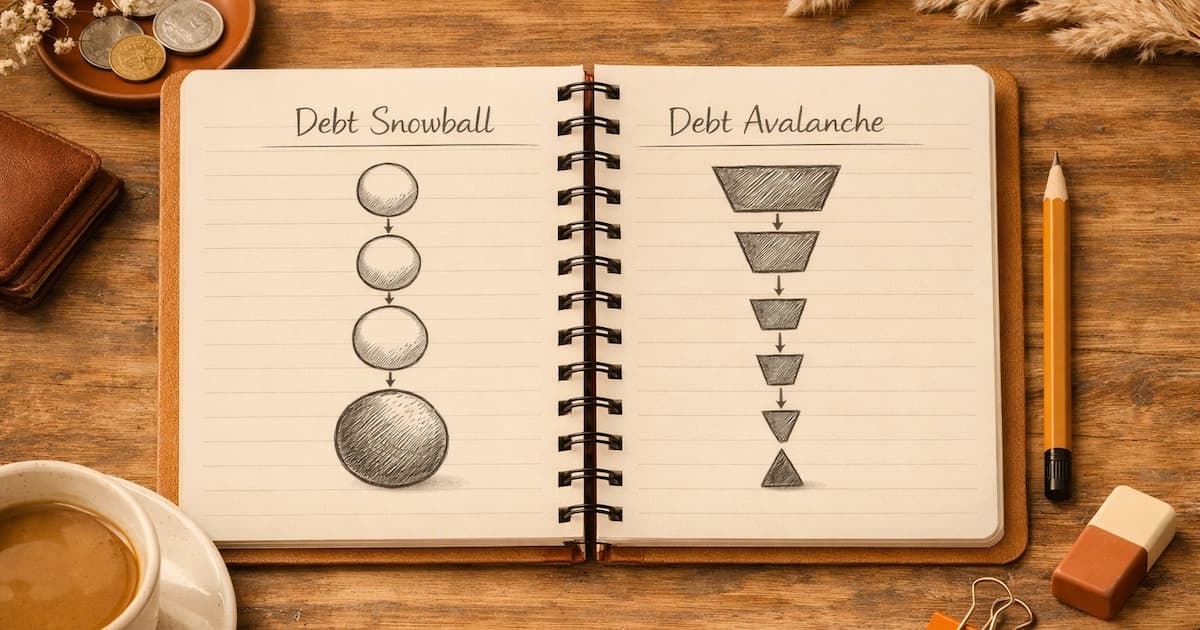
How each method works, the maths on which saves more, the behavioural research on which one people actually finish, and how to choose.
11 min read

Credit card interest is charged daily on your average daily balance once you carry a balance. The real math, grace periods, and the minimum trap, in ₹ and $.
13 min read