Budgeting Tips for Freelancers: Variable Income and Tax

By Tapabrata Biswas · Published May 10, 2026 · 10 min read
Researched with AI assistance, reviewed and edited by Tapabrata Biswas.

A freelancer who invoices $80,000 a year may take home only $50,000-$55,000 after self-employment tax, federal and state income tax, business expenses, and out-of-pocket health insurance. Three common employee budgeting tips actively work against freelancers: paying yourself last, treating the gross deposit as the budget number, and assuming an emergency fund of three months is enough.
The standard advice, "budget against your monthly income", assumes the monthly income is the same each month. For a freelancer, the income arrives in lumps, on irregular schedules, and at amounts that vary substantially from one month to the next. The good news is that the underlying budgeting frameworks still work. They just need adaptations specific to self-employment.
Tip 1: budget against the lowest reliable month, not the average
Salaried employees can budget against the predictable monthly paycheck. Freelancers cannot. The instinct is to budget against the average, but averaging across high and low months produces a budget that's too rich for the lean months and too lean for the rich ones, and the lean months are when the budget actually has to function.
A more durable approach: pull income for the last 6-12 months, find the lowest reliable monthly figure (excluding any obvious one-off windfalls), and treat that as the baseline budget. The rest is bonus, assigned to taxes, the emergency fund, retirement, or specific irregular expenses, but not used for monthly fixed costs.
That's essentially the variable-income adaptation of zero-based budgeting. Every dollar still gets a job; the difference is that the job assignments depend on which month it is.
Tip 2: set aside taxes the moment money lands, not at quarter end
Self-employed workers in the U.S. pay both the employee and employer portion of Social Security and Medicare (15.3% combined as self-employment tax) plus federal and state income tax. The IRS expects quarterly estimated tax payments on April 15, June 15, September 15, and January 15.
The durable practice: the moment a client payment lands, transfer 25-30% of it to a separate tax-only savings account. The percentage depends on income bracket, state, and any business deductions, but the order matters more than the precise number. Treat the post-tax amount as the actual money available; the tax reserve isn't yours to spend.
That's the freelancer version of pay yourself first, except the "self" being paid first is the IRS and not the savings account. The IRS gets the first transfer; the savings account gets the second. The remainder is what the household actually budgets against.
The structure of self-employment income reporting on the 1099 form doesn't include any tax withholding, which is why this discipline matters. There's no employer doing it on your behalf.
Tip 3: separate the business account from the personal account
Mixing client payments and personal spending in one account makes everything harder: taxes, accounting, monthly budgeting, savings tracking. The two-account structure that almost every long-term freelancer uses works like this:
A business checking account receives every client payment. From there, transfers go out to the tax reserve, the business savings (irregular expenses, equipment, software subscriptions), and a fixed monthly transfer to personal checking.
A personal checking account receives the fixed monthly transfer and runs on it. That's the account the household actually budgets against.
The advantage is that personal budgeting becomes salaried-employee-style, predictable monthly amount, normal categories, normal tracking, even though the underlying income is variable. The variability is absorbed by the business account and the buffer.
Tip 4: pay yourself a fixed monthly "salary"
Once the two-account structure is in place, decide on a fixed amount that transfers from business to personal each month. The amount should be lower than the average net (after-tax) monthly income, so the business account accumulates a buffer in good months that covers shortfalls in lean months.
A common starting figure: 70-80% of the lowest reliable monthly net income (after tax reserve). For a freelancer whose lowest recent month was $3,500 net of tax, the personal "salary" would be $2,450-$2,800. The remainder builds the buffer that smooths future variability.
After the buffer reaches a target size (often three months of personal expenses), additional surplus rolls into longer-term savings: emergency fund, retirement, or business reinvestment.
Tip 5: the emergency fund needs to be larger
The standard salaried-employee guidance is three to six months of expenses. For freelancers, six to twelve months is more typical, for two reasons: income can drop suddenly when a major client leaves; and downturns often hit freelance industries (consulting, creative, marketing) earlier and harder than salaried sectors. A six-month emergency fund for a salaried employee assumes they'll find another job; a six-month emergency fund for a freelancer assumes a project pipeline can be rebuilt within that window.
Build the emergency fund alongside the buffer in the business account. Some freelancers keep them as one combined pool; others keep them separate (buffer for monthly smoothing, emergency fund for genuine income loss).
Tip 6: track gross-to-net carefully
For salaried employees, the difference between gross and net income shows up on the pay stub automatically. For freelancers, every gross dollar needs to be reduced by:
- Self-employment tax (15.3% on net earnings up to the Social Security wage base, then 2.9% above)
- Federal income tax (whatever bracket applies)
- State income tax (varies by state)
- Business expenses (deductible from taxable income)
- Health insurance premiums (often paid out-of-pocket rather than employer-subsidised)
A freelancer who invoices $80,000 in a year may net only $50,000-$55,000 after all of the above. Budgeting against $80,000 produces a year-end surprise that ends careers.
Tip 7: keep a "next quarter's tax payment" account separate from operating cash
The four quarterly tax deadlines are predictable. The cash to meet them needs to be present on those dates. A common pattern: the tax reserve account holds the rolling tax obligation from each invoice; on the quarterly deadline, the IRS payment goes out from that account directly. Mixing tax cash with operating cash means a slow-paying client can leave the freelancer technically able to pay rent but unable to pay quarterly taxes, a position that compounds badly when the next quarter arrives before the previous quarter is fully reserved.
Tip 8: track invoices and not just income
For freelancers, "income" can mean four different things: invoices sent, invoices accepted, invoices paid, or cash in hand. The first three can sit unpaid for 30-90 days. The fourth is what the budget runs against. Many freelancer cash crises come from confusing the first with the fourth, assuming a $5,000 invoice sent on the 1st is "income for the month" when in practice it doesn't land until day 50.
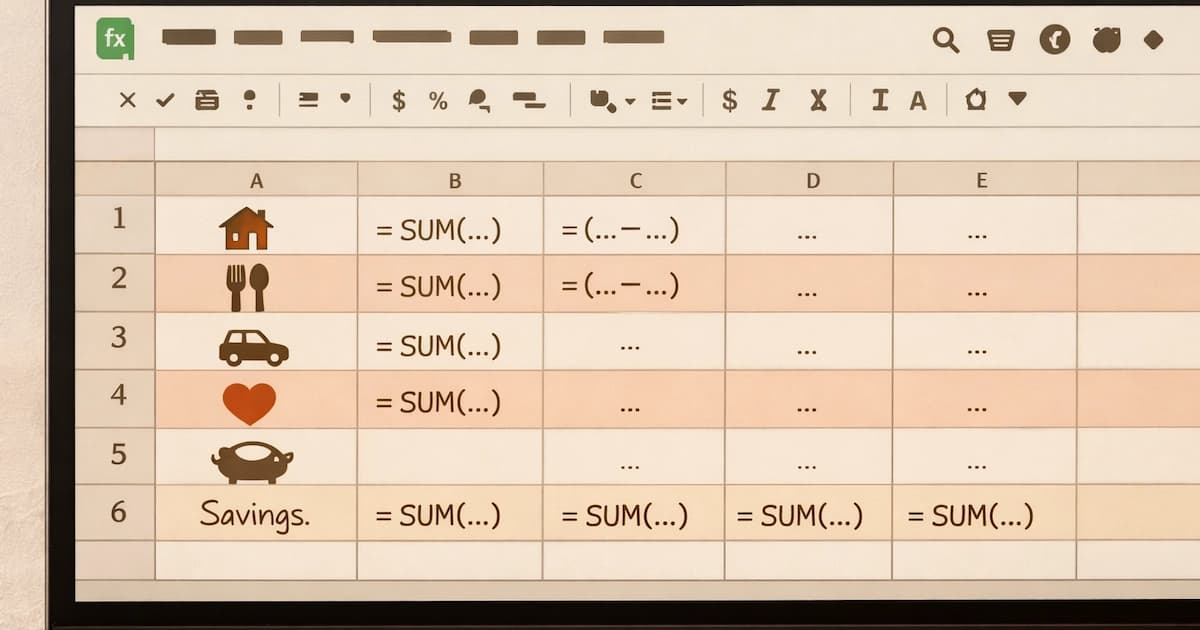
A simple invoice-tracking spreadsheet with columns for invoice date, due date, amount, and paid date keeps the distinction visible. Cash flow planning should run from the "paid date" column, and the spending side can sit in the same file if you build a budget in Google Sheets.
Tip 9: the irregular expenses are still expected
Freelancers have many recurring-but-irregular expenses that catch beginners by surprise: annual software subscriptions, equipment replacement, professional development, conference attendance, accounting and tax preparation fees, business insurance. Each of these is a known annual expense that arrives as a single bill.
The standard fix is sinking funds: small monthly transfers to dedicated accounts that accumulate to cover the annual bill. A $1,200 annual accounting fee becomes a $100 monthly transfer to a "tax prep" sinking fund. By the time the bill arrives, the money is already there.
Tip 10: review quarterly and not just monthly
Salaried employees can review their budget monthly because the income is the same monthly. Freelancers benefit from a quarterly review that aligns with tax deadlines: assess income, expenses, tax reserves, buffer status, and emergency fund growth all at once. The quarterly cadence catches drift that monthly reviews miss (e.g., a slow build-up of underpriced projects) and pairs naturally with the IRS deadlines that are happening anyway.
Common mistakes freelancers make
Five patterns trip freelancers up regularly.
The first is budgeting against gross invoiced amounts. Treating $5,000 invoiced as $5,000 spendable produces a tax bill that ends careers.
The second is not separating tax money from operating money. When the quarterly bill arrives, "I'll cover it from this month's income" is the freelancer equivalent of credit card overspending. It borrows from the future to fund the present.
The third is too small an emergency fund. Three months of expenses is enough for a salaried worker who can find another job; a freelancer needs the runway to rebuild a pipeline.
The fourth is paying yourself the full average. Paying out the average month's income leaves nothing in the business account to absorb below-average months.
The fifth is counting unpaid invoices as income. A signed contract isn't money in the bank. Cash flow planning runs from when payment lands, not when invoices are sent.
What experts say
The IRS's self-employment tax guide covers the 15.3% self-employment tax mechanics that drive much of the tax-reserve advice above.
The Consumer Financial Protection Bureau's emergency fund guide recommends larger reserves for income-variable households, consistent with the 6-12 month rule of thumb above.
Frequently asked questions
How do freelancers budget with variable income? Most freelancers budget against the lowest reliable monthly income from the last 6-12 months, treat it as the baseline, and assign anything above that to savings, taxes, or specific irregular expenses. Building the budget around the worst recent month rather than the best protects against the lean periods that always eventually arrive.
How much should freelancers set aside for taxes? A common rule of thumb in the U.S. is 25-30% of every payment to a separate tax account, depending on your federal bracket and state tax. The IRS expects quarterly estimated tax payments from self-employed workers, so the savings need to be available on the four quarterly deadlines. Underestimating taxes is the most common freelancer financial mistake.
Do freelancers need an emergency fund larger than employees? Yes. The standard advice for employees is 3-6 months of expenses; for freelancers, 6-12 months is more typical because both income and demand can disappear simultaneously during downturns. Larger client losses or seasonal slowdowns can take months to replace.
Should freelancers pay themselves a salary from their business account? Many full-time freelancers run a two-account system, a business checking account that receives all client payments, and a personal checking account that receives a fixed monthly transfer. The business account holds the variable income, the tax reserve, and the quarterly payment buffer. The personal account runs on a steady monthly amount, smoothing the variability.
In summary
Freelancer budgeting needs three structural adaptations beyond standard employee budgeting: separate accounts for business and personal money, automatic tax reserves on every invoice paid, and a budget built against the lowest reliable month rather than the average. The tax reserve and the buffer are non-negotiable; without them, lean months become crises and quarterly tax deadlines become emergencies.
The single highest-leverage habit for a new freelancer is the 30% transfer-on-receipt to a tax-only account. Done from the very first invoice, it removes most quarterly tax surprises before they happen. Skipped in year one, it creates a tax debt that compounds across years.
If you're picking a framework to layer these adaptations onto, our budgeting methods explained guide covers the main options.
Sources
- IRS, Self-Employment Tax (Social Security and Medicare Taxes): irs.gov/businesses/small-businesses-self-employed/self-employment-tax-social-security-and-medicare-taxes
- Consumer Financial Protection Bureau, An Essential Guide to Building an Emergency Fund: consumerfinance.gov/an-essential-guide-to-building-an-emergency-fund
- Investopedia, Self-Employment Tax: investopedia.com/terms/s/selfemploymenttax.asp



You might also like

Give every rupee a job until income minus spending is zero. The five steps, a worked example in rupees and dollars, and where it breaks down.
14 min read

The 1099-NEC threshold rose from $600 to $2,000 for payments made after 31 December 2025. What each variant reports, and the Indian form that matches it.
10 min read

India quotes CTC. The US quotes gross. Neither is what lands in your account, and the US employer's 7.65% is the part nobody puts in the offer letter.
12 min read