How the Debt Avalanche Works: The Math and Its Limit

By Tapabrata Biswas · Updated July 23, 2026 · 10 min read
Researched with AI assistance, reviewed and edited by Tapabrata Biswas.
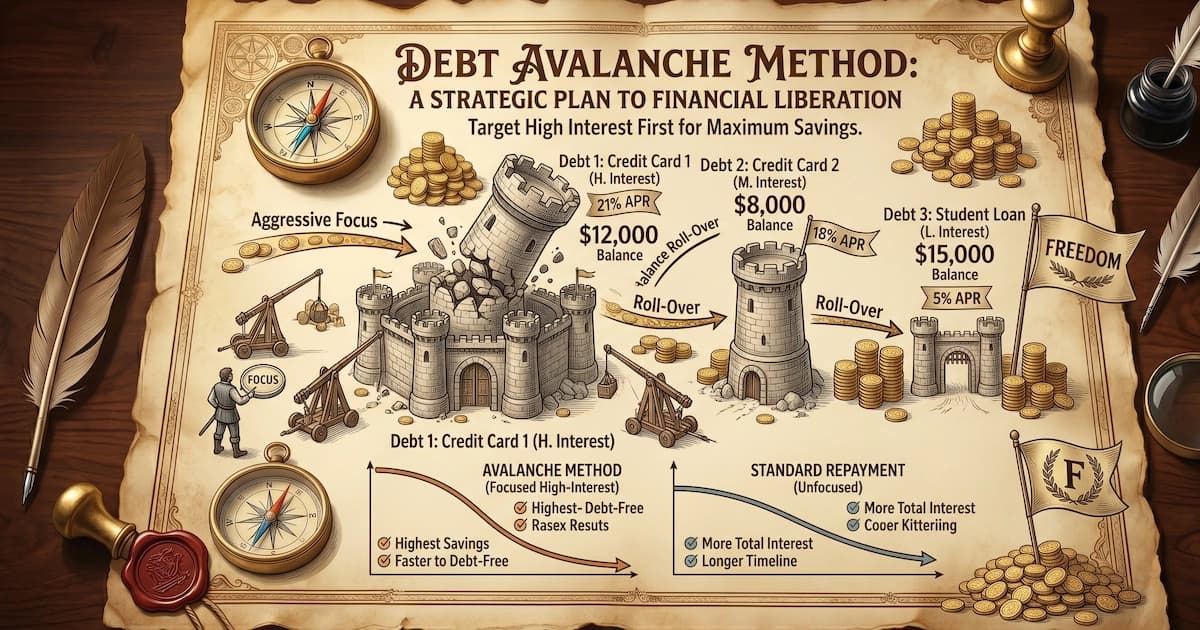
Every article on the debt avalanche tells you it saves the most money. Almost none tells you how much, and the honest answer is that it ranges from a lot to almost nothing.
We simulated it both ways, month by month. On one realistic Indian debt stack the avalanche saved ₹16,710 over the alternative. On another, with the same method, it saved under ₹1,600. The difference was not the method. It was where the high interest rate happened to sit.
So this covers how the avalanche works, then the part the ranking pages leave out: the two-sided story of when the maths is worth the discomfort and when it is not. The head-to-head decision against the snowball has its own comparison; this page is about the mechanics and the numbers underneath them.
What is the debt avalanche method?
The debt avalanche is a payoff order that ranks debts by interest rate, highest first, and directs every spare rupee at the most expensive one until it clears. You pay the minimum on everything else, and when the top debt closes, its payment rolls down onto the next-highest rate.
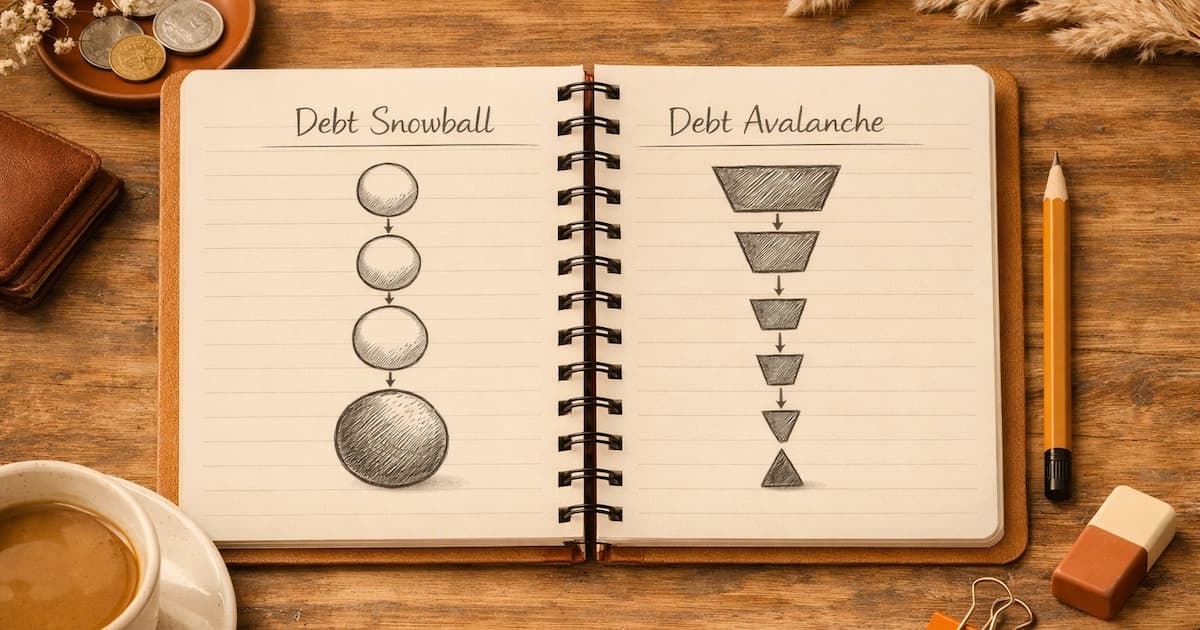
That rollover is where the name comes from. Each cleared debt frees its minimum, and that freed money piles onto the next target, so the amount hitting each successive debt grows like a slide gathering snow.
The rule that defines it is a single line: order by rate, never by balance. That is also the one line that separates it from the debt snowball, which orders by balance, smallest first. Same rollover mechanic, opposite starting point.
How does the avalanche work, step by step?
Five steps, and the first one is the only one that takes any thought.
- List every debt with its balance, interest rate and minimum payment. Sort the list by rate, highest at the top. The balance column does not affect the order.
- Add up all the minimums, then add whatever extra you can pay above them. That total is your monthly debt budget, and it stays fixed through the payoff.
- Pay the minimum on every debt. Put all the extra on the top debt only.
- When the top debt clears, move its whole payment, minimum plus extra, onto the new top debt.
- Repeat until the last debt is gone.
One practical note the method needs and the snowball does not. Avalanche progress is slow to see, because the highest-rate debt is often not the smallest, so the first close can take a while. A running tally of interest saved against a snowball baseline is the substitute for the satisfaction of an early cleared account.
Worked example: when the avalanche wins
On a debt stack where a large balance carries the highest rate, the avalanche's advantage is real and worth having. An Indian household, simulated month by month at a fixed ₹33,000 a month.
| Debt | Balance | Rate | Minimum |
|---|---|---|---|
| Credit card | ₹1,50,000 | 40% | ₹7,500 |
| Personal loan | ₹2,00,000 | 16% | ₹6,500 |
| Gold loan | ₹1,00,000 | 11% | ₹4,000 |
Minimums come to ₹18,000, plus ₹15,000 extra, so ₹33,000 goes out each month. The avalanche order is card, then personal loan, then gold loan.
| Method | Total interest | Months |
|---|---|---|
| Avalanche (card at 40% first) | ₹60,502 | 16 |
| Snowball (gold loan, smallest, first) | ₹77,212 | 16 |
The avalanche saves ₹16,710, and both finish in the same 16 months. The card clears around month 8. The saving is large here for one reason: the 40% rate sits on ₹1,50,000, so every month that balance survives is expensive, and killing it first stops the bleeding early.
The US version tells the same story in dollars. Three debts, a card at 24% on $8,000, a personal loan at 12% on $5,000, an auto loan at 6% on $6,000, paid at a fixed $930 a month:
| Method | Total interest | Months |
|---|---|---|
| Avalanche (24% card first) | $2,639 | 24 |
| Snowball (smallest first) | $3,762 | 25 |
The avalanche saves about $1,123 and finishes a month sooner. US card rates in this range are realistic: the Federal Reserve's G.19 release put the average credit card rate at 20.94% in May 2026, with retail cards higher.
When does the avalanche barely matter?
Move the high rate onto a small balance and the whole advantage collapses, which is the case no competitor page will show you. Take an Indian household whose most expensive debt is a small one.
| Debt | Balance | Rate | Minimum |
|---|---|---|---|
| Buy-now-pay-later | ₹8,000 | 0% | ₹1,500 |
| Credit card | ₹35,000 | 39% | ₹3,500 |
| Personal loan | ₹1,80,000 | 14% | ₹5,500 |
| Two-wheeler loan | ₹65,000 | 11% | ₹2,800 |
Run the same simulation and the avalanche saves about ₹1,570 over the snowball, and both finish in the same month. The 39% rate looks alarming, but it sits on ₹35,000, so clearing it a few months early saves very little. Most of the debt is the ₹1,80,000 personal loan at a middling 14%, where the two methods treat it almost identically.
The lesson is a formula worth remembering: the prize is the rate multiplied by the balance under it, not the rate alone. A 40% rate on ₹5,000 is a smaller problem than a 16% rate on ₹2,00,000. When you list your own debts, the ones worth attacking first are the ones where a high rate meets a high balance.
This is exactly where the honest choice between methods lives. When the avalanche saves ₹16,000, the maths earns its keep. When it saves ₹1,500, the method you will actually finish matters more, and that trade-off is the whole subject of the snowball versus avalanche comparison.
Where do a home loan and a gold loan fit?
At the bottom of the list, receiving only their minimum, and that is almost always the right place for them. A home loan in India commonly sits well under 10%, and a gold loan below unsecured rates, so the avalanche's rate ordering naturally pushes both to last.
That is not the method failing to notice them. It is the method working. Their rate is the cheapest borrowing you hold, so diverting extra money to a 9% home loan while a 40% card runs is the opposite of the avalanche's logic. For most households running an avalanche, the extra payment clears the unsecured debt and the schedule ends before the home loan ever becomes the target.
The one thing to watch is a mental error rather than a maths one: a large balance can feel like the urgent problem even when its rate is low. The home loan is usually the biggest number on the page and the least urgent line on it. How the rate itself is charged, and why a card at 40% compounds so much faster than a loan at 11%, is covered in how credit card interest works.
What this post deliberately does not cover
This explains how the avalanche method orders and pays debts, and what changes the size of its advantage. It does not tell you which method to use, whether to consolidate, or how to handle a debt you cannot afford the minimum on, since those turn on circumstances a worked example cannot see.
Several neighbouring subjects sit elsewhere on purpose. The behavioural case for the snowball, and the head-to-head decision, are in snowball versus avalanche. The snowball's own mechanics are in how the debt snowball works. Replacing several debts with one new loan is debt consolidation, a different tool with its own arithmetic.
Two limits on the numbers here. The worked examples use realistic but illustrative rates and balances, run through a fixed monthly budget, so your own figures are the ones that matter; the debt payoff calculator runs the same month-by-month simulation on your actual debts. And a debt you genuinely cannot service is not a payoff-ordering problem but a different one, where a qualified credit counsellor is the right call rather than any method on this page.
Frequently asked questions
How does the debt avalanche method work? The debt avalanche orders your debts by interest rate from highest to lowest, ignoring the balances. You pay the minimum on every debt, then put every spare rupee or dollar onto the highest-rate debt until it clears. When it closes, the money that was going to it rolls onto the next-highest-rate debt, and so on down the list. Because the most expensive debt is always the one being attacked, the method minimises the total interest you pay across the whole payoff. It is the mathematically optimal order whenever the rates differ.
Does the debt avalanche always save a lot of money? No, and this is the part most explainers skip. The avalanche saves the most interest of any method, but how much that is depends on the balance sitting under the high rate more than the rate itself. A 40% card with a large balance makes the avalanche worth a lot: in our simulation a ₹1,50,000 card at 40% helped the avalanche save ₹16,710 over the snowball. A high rate on a small balance saves very little, sometimes only a few hundred rupees, because there is not much expensive debt to kill early. When the saving is that small, the method that keeps you going matters more than the one that is optimal on paper.
Which debt do I pay first in the avalanche method? The one with the highest interest rate, whatever its balance. This is the single rule that separates the avalanche from the snowball, which starts with the smallest balance. So a ₹40,000 credit card at 40% is attacked before a ₹2,00,000 personal loan at 16%, even though the loan is five times larger, because the card is the most expensive money you hold. You still pay the minimum on the loan and everything else each month. Only the extra, above all the minimums, goes to the highest-rate debt.
Where does a home loan or gold loan fit in the avalanche? Last, in almost every case, and that is usually correct. A home loan in India is commonly the lowest rate you hold, often well under 10%, and a gold loan sits below unsecured debt too. Since the avalanche attacks the highest rate first, these secured debts fall to the bottom of the list and receive only their minimum until everything above them clears. Because their rate is the cheapest borrowing you have, there is rarely a case for diverting extra money to them ahead of a 40% card. For most households the extra never reaches the home loan at all.
Should I use the avalanche or the snowball? It depends on whether your problem is arithmetic or motivation, which is a genuine head-to-head worth its own comparison. The avalanche wins on total interest, always, when rates differ. The snowball, which clears the smallest balance first, wins on the psychology of visible progress, and a snowball you finish beats an avalanche you abandon. The honest deciding question is how large the avalanche's money advantage actually is for your specific debts: when it is ₹16,000 the maths is worth some discomfort, and when it is ₹1,500 the method you will stick with matters more.
Sources
-
Board of Governors of the Federal Reserve System, G.19 Consumer Credit, release of 8 July 2026 (the average US credit card rate of 20.94% and the 24-month personal loan rate of 11.86% for May 2026, used to keep the worked example rates realistic) federalreserve.gov
-
Gal, D. and McShane, B., Can Small Victories Help Win the War? Evidence from Consumer Debt Management, Journal of Marketing Research, 2012, via Northwestern Kellogg (the finding that closing accounts predicts successful payoff, which underlies the snowball's behavioural case and the honest limit on the avalanche's advantage) kellogg.northwestern.edu
-
The Money Decoded, Debt Payoff Calculator (the month-by-month simulation of both methods on any set of debts, which produced the interest and timeline figures in this post) themoneydecoded.com



You might also like
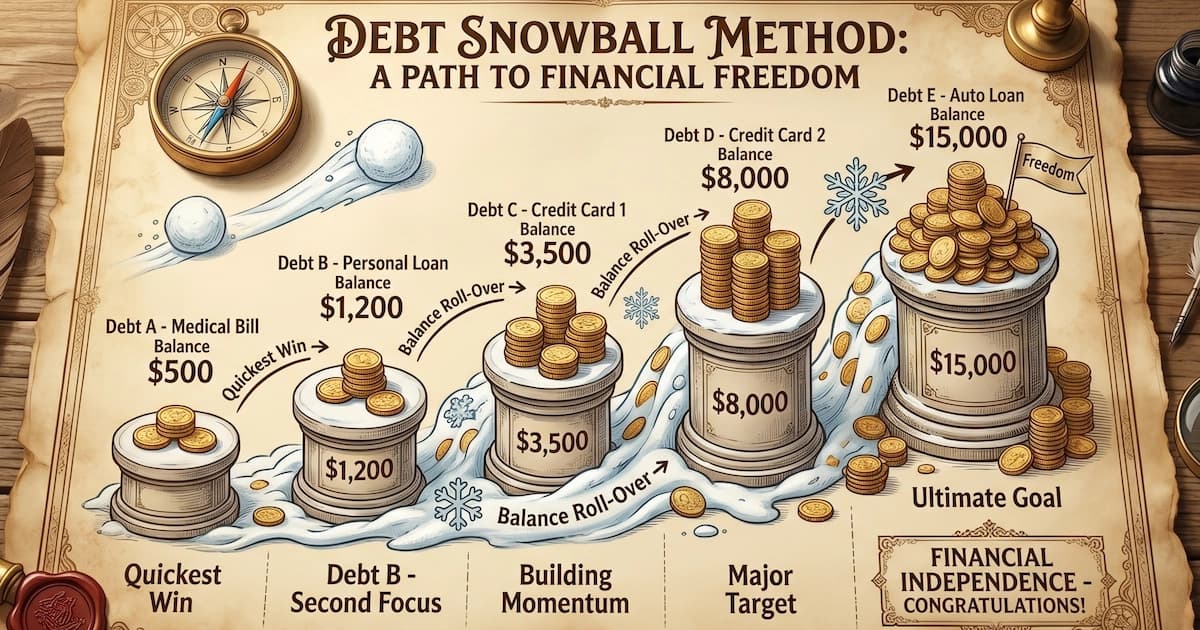
Pay the smallest balance first, roll each payment forward, and stay motivated. Worked payoff examples in both rupees and dollars.
12 min read
How each method works, the maths on which saves more, the behavioural research on which one people actually finish, and how to choose.
11 min read

The three forms debt consolidation takes in India and the US, and the conditions under which it saves money rather than just rearranging it.
11 min read