What Is Income-Driven Repayment? The Five Plans in 2026

By Tapabrata Biswas · Updated September 16, 2026 · 16 min read
Written and fact-checked by Tapabrata Biswas. How I write
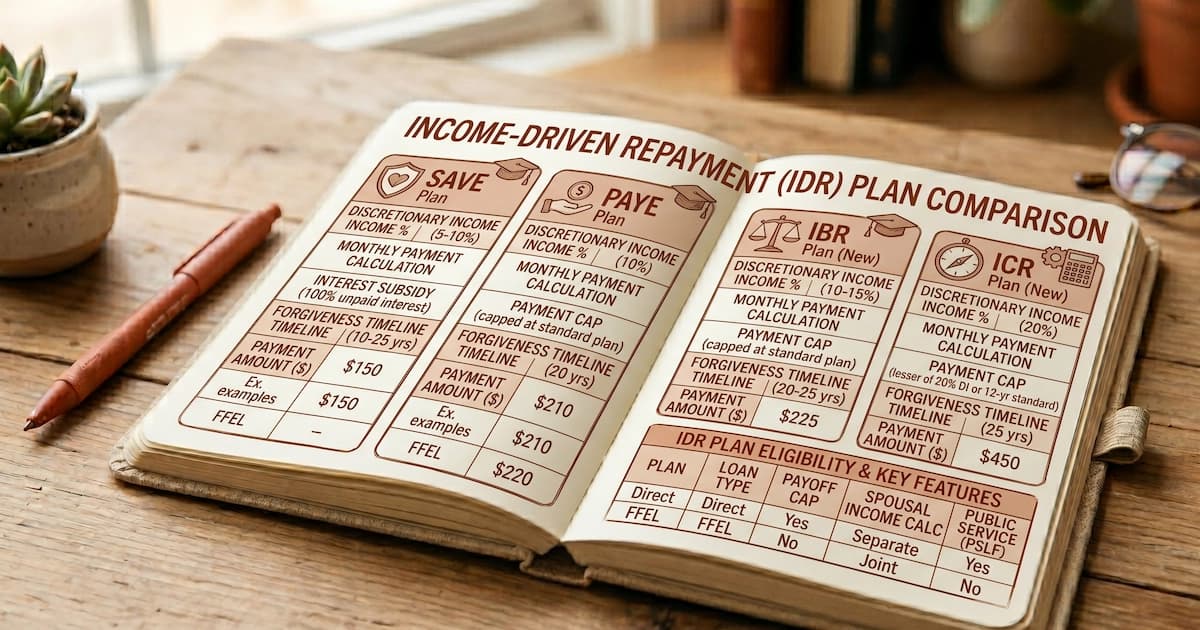
A student who borrowed for the 2026-27 academic year has exactly one income-driven repayment plan available to them, and it is not one of the four that dominate the search results. The regulation closed PAYE, IBR and ICR to Direct Loans made from 1 July 2026, leaving the Repayment Assistance Plan. It charges a slice of every dollar of income, not only the part above the poverty line, and it forgives after 30 years where the older plans forgive after 20.
Income-driven repayment is a US-only programme, run by the Department of Education, with no direct equivalent in India. This post covers what it is, all five plans and who can still join each, how the new Repayment Assistance Plan calculates a payment, the forgiveness clocks, why forgiven balances are taxable again from 2026, and the closest options Indian borrowers have when EMIs become unaffordable. Every plan rule below is cited to 34 CFR 685.209, read on 16 September 2026.
What is income-driven repayment
Income-driven repayment is a set of US federal student loan repayment plans that cap the monthly payment at a percentage of the borrower's discretionary income rather than at the amortisation amount required to clear the loan over a fixed period. The plans are governed by 34 CFR 685.209 and administered by Federal Student Aid through loan servicers (MOHELA, Nelnet, Aidvantage, EdFinancial, Default Resolution Group).
The structural insight behind IDR is that federal student loans are non-dischargeable in bankruptcy (with very narrow exceptions) and have no income-eligibility limits at origination, meaning many borrowers end up with debt loads disproportionate to their post-degree income. IDR creates a release valve: payments scale to what the borrower can actually pay, and the unpaid balance is eventually forgiven.
Five plans now operate under the IDR umbrella. Four of them work on discretionary income, each using a different percentage and a different poverty-line multiple. The fifth, RAP, abandons discretionary income entirely.
The five IDR plans, and which ones are still open to you
There are five income-driven repayment plans, and the regulation says so plainly. 34 CFR 685.209(a) opens with "The five IDR plans are" and lists REPAYE, "which may also be referred to as the Saving on a Valuable Education (SAVE) plan", then IBR, PAYE, ICR, and the Repayment Assistance Plan.
Which of them you can actually use turns on a single date: whether you took a Direct Loan on or after 1 July 2026.
| Plan | Payment formula | Forgiveness | Who can still use it |
|---|---|---|---|
| Repayment Assistance Plan (RAP) | A band of AGI, from $120 a year below $10,000 up to 10% above $100,000, divided by 12, then minus $50 a month per dependent | 360 payments over at least 30 years | Everyone, and the only income-driven option for loans taken from 1 July 2026 |
| IBR | 10% of discretionary income for a new borrower, 15% otherwise, above 150% of the poverty guideline | 20 or 25 years | Direct Loans made before 1 July 2026, plus FFEL |
| PAYE | 10% of discretionary income above 150% of the poverty guideline | 20 years | Direct Loans made before 1 July 2026 |
| ICR | 20% of discretionary income above 100% of the poverty guideline | 25 years | Direct Loans made before 1 July 2026 |
| REPAYE, also called SAVE | 5% of discretionary income on undergraduate balances, 10% otherwise, above 225% of the poverty guideline | 20 or 25 years, or 120 payments if the original balance was $12,000 or less | Through 30 June 2028, and only if no Direct Loan was taken from 1 July 2026 |
The regulation is explicit about the cut-off. Paragraph (d)(5) states that "only Direct Loans made before July 1, 2026, may be repaid under the PAYE, IBR, and ICR plans." So a student who borrowed in the 2026-27 academic year has one income-driven plan available, and it is RAP.
One caveat on the REPAYE row, because two things are true at once. The regulation still lists the plan and sets its window through 30 June 2028. The Department has separately described SAVE as unlawful and has been moving enrolled borrowers onto other plans. If you are currently in it, your servicer's instruction governs what happens to your account, not the regulation's outer date.
How the Repayment Assistance Plan actually works
RAP charges a percentage of your entire adjusted gross income, with no poverty-line deduction at any point. That single difference separates it from every plan that came before, all of which subtract a multiple of the federal poverty guideline first and charge only on what is left.
The bands, from 685.209(b)(2), are an annual figure:
| Adjusted gross income | Base payment for the year |
|---|---|
| Not more than $10,000 | $120 |
| $10,001 to $20,000 | 1% of AGI |
| $20,001 to $30,000 | 2% |
| $30,001 to $40,000 | 3% |
| $40,001 to $50,000 | 4% |
| $50,001 to $60,000 | 5% |
| $60,001 to $70,000 | 6% |
| $70,001 to $80,000 | 7% |
| $80,001 to $90,000 | 8% |
| $90,001 to $100,000 | 9% |
| More than $100,000 | 10% |
Paragraph (f)(5) then turns that into a monthly bill: the base payment "divided by 12", minus "$50 for each dependent of the borrower".
Work it on a real number. A single borrower with an AGI of $50,000 and no dependents sits in the 4% band, so the base payment is $2,000 a year and the monthly payment is about $167. Add two dependents and it falls to about $67.
Reading the low percentages as generosity is the mistake waiting to be made here. RAP's 4% applies to every dollar of AGI. IBR's 10% applies only to income above 150% of the poverty guideline, which for many borrowers removes a large slice before the percentage touches anything. Which plan costs less depends entirely on where your income sits, and the headline rate will not tell you.
Two provisions soften it. Under (o)(1), if the payment cannot cover the principal due, that principal payment is postponed. And under (o)(2)(i), in any month an on-time payment reduces principal by less than $50, the Secretary reduces the principal by the difference, up to $50. That is a subsidy the older plans do not carry.
How the discretionary income formula works
Discretionary income is the pivot point of every IDR plan. It is defined as the borrower's adjusted gross income (AGI from the federal tax return) minus a multiple of the federal poverty guideline for the borrower's family size and state of residence.
A worked example using 2024 federal poverty guidelines (single individual in the 48 contiguous states): $15,060.
For a single borrower with $50,000 AGI and $40,000 in undergraduate Direct loans:
Under SAVE (5% rate, 225% poverty threshold):
- 225% of poverty: $15,060 × 2.25 = $33,885
- Discretionary income: $50,000 − $33,885 = $16,115
- Annual payment: $16,115 × 5% = $806
- Monthly payment: roughly $67
Under IBR new borrower (10% rate, 150% poverty threshold):
- 150% of poverty: $15,060 × 1.50 = $22,590
- Discretionary income: $50,000 − $22,590 = $27,410
- Annual payment: $27,410 × 10% = $2,741
- Monthly payment: roughly $228
Under standard 10-year amortisation at 6.53%:
- Monthly payment: roughly $455
The same borrower pays $67, $228, or $455 depending on the plan, a 6.8x range driven entirely by the formula. The trade-off is that lower monthly payments mean longer payment terms and substantially more total interest paid over the life of the loan, unless the borrower's balance is forgiven first. Understanding the difference between gross and net income matters here because IDR uses AGI from the W-2 form and tax return, not gross salary.
The 20- or 25-year forgiveness clock
Every IDR plan ends in forgiveness of any remaining balance after a defined number of qualifying monthly payments, but the number is no longer the same across plans. On PAYE, IBR, ICR and REPAYE the clock is 240 monthly payments (20 years) for borrowers with only undergraduate loans and 300 monthly payments (25 years) for borrowers with any graduate-level federal loans.
RAP runs half as long again. Paragraph (k)(7) gives forgiveness "after the borrower has satisfied 360 monthly payments or the equivalent" over a period of at least 30 years. A borrower who takes the only plan available to them from 1 July 2026 waits a decade longer than one who borrowed a year earlier.
There is a small-balance exception worth knowing on the older side. Under (k)(3), a REPAYE borrower whose total original principal was $12,000 or less reaches forgiveness after 120 monthly payments.
Qualifying payments include:
- Monthly payments made on time under any IDR plan
- $0 monthly payments calculated under the IDR formula for low-income borrowers (a $0 payment still counts toward the clock)
- Payments made under the standard 10-year plan if later switching to IDR
- Periods of qualifying deferment in some cases (economic hardship, military service)
Periods of forbearance and most other deferments do not count.
The forgiveness benefit can be substantial. A borrower who graduates with $40,000 in undergraduate loans, makes 240 qualifying SAVE payments averaging $200/month over 20 years, has paid $48,000 against the loan. Depending on interest accrual and capitalisation, the remaining forgiven balance could range from $0 (loan fully paid down) to $60,000+ (loan ballooned despite payments). The forgiven amount is the actual benefit of the programme.
Tax implications of forgiven IDR balances
Historically, forgiven IDR balances were treated as taxable income under IRC Section 61(a)(11), the cancellation-of-debt rules. A borrower forgiven of $30,000 would have $30,000 added to their AGI in the forgiveness year, potentially producing a federal tax bill in the $5,000-$8,000 range depending on bracket.
The American Rescue Plan Act of 2021 amended IRC Section 108 to exclude federal student loan forgiveness from taxable income through 31 December 2025. That question is now settled, and it settled the unhelpful way. The exclusion was not extended, so it lapsed on schedule.
The IRS Taxpayer Advocate Service, writing in March 2026, puts the window at loans "forgiven after December 31, 2021, and on or before December 31, 2025". Forgiveness arriving from 1 January 2026 is once again cancellation-of-debt income, reported to the borrower on Form 1099-C and carried onto Form 1040 for the year the debt was cancelled.
Three categories were never inside the temporary rule and are unaffected: Public Service Loan Forgiveness, Teacher Loan Forgiveness, and discharges for death or total and permanent disability. Those sit in separate permanent provisions and remain tax-free. A borrower who is insolvent when the debt is cancelled may also use Form 982 to exclude some or all of it.
The practical consequence lands hardest on the plan with the longest clock. A RAP borrower reaching forgiveness at year 30 gets a tax bill in that year unless the law changes again before then.
State tax treatment varies. Most states conform to the federal exclusion, but a handful (Mississippi, Wisconsin, North Carolina, Indiana, Arkansas, and Minnesota among them at various points) have either taxed forgiven loans at the state level or required separate analysis. Borrowers approaching forgiveness should check their state's current rule with a tax professional in the year before forgiveness arrives.
Eligibility and recertification
To enrol in an IDR plan, a borrower applies through their loan servicer or directly at studentaid.gov. The application requires:
- Proof of income (most recent federal tax return, pay stubs, or self-certification of zero income)
- Family size and state of residence (used to look up the federal poverty guideline)
- Spouse's income and loan information if married and filing jointly
Once enrolled, the borrower must recertify income and family size annually. Failure to recertify on time triggers automatic conversion to the standard 10-year payment plan and capitalisation of any accrued interest, a significant cost penalty for missing a paperwork deadline. Federal Student Aid sends reminders 60 days before recertification is due, but the responsibility sits with the borrower.
For a borrower whose income drops mid-year (job loss, reduced hours), the income-driven payment can be recalculated immediately upon request. They are not required to wait for the annual recertification cycle.
What India offers instead
India does not have an income-driven repayment programme for education loans. The closest tools available to a borrower facing genuine repayment stress are negotiated rather than statutory:
- EMI restructuring under bank discretion. Indian banks can extend the loan tenure (lowering the EMI) or grant a temporary moratorium on principal repayment (interest-only EMIs) for borrowers with documented hardship. The decision is bank-by-bank and case-by-case.
- RBI's restructuring framework for stressed retail loans. During acute economic events (the 2020-22 COVID restructuring window, for example), RBI has issued frameworks permitting banks to restructure retail loans including education loans. These frameworks have not been a permanent feature.
- One-time settlement (OTS). For loans that have already become non-performing assets, banks may accept a lump-sum payment of less than the full outstanding balance to close the account. OTS damages the borrower's CIBIL score for years afterward and is reserved for genuinely distressed cases.
- Education loan extension under further studies. A borrower who returns for additional study (PG after UG, PhD after PG) can request a fresh moratorium during the second course. Interest continues to accrue, but EMIs pause.
None of these match the structural nature of IDR: automatic, formulaic, and ending in forgiveness. The Indian system assumes borrowers will repay in full.
What experts say
Federal Student Aid's IDR information hub is the authoritative source for current plan rules, payment formulas, and application procedures. The same site hosts the official Loan Simulator that calculates payments under each plan based on actual loan balances and AGI.
The Consumer Financial Protection Bureau's student loan complaint analysis has identified IDR application processing errors and recertification confusion as top complaint categories across recent reporting cycles. The pattern reflects how administratively complex the programme is and how much depends on the servicer correctly processing the paperwork.
The Reserve Bank of India's annual Trend and Progress of Banking in India report tracks the education loan portfolio of Indian banks and the rising NPA rate among education loans, a data point that has prompted occasional policy discussion about borrower protection mechanisms but has not produced an Indian IDR equivalent. For broader context on how loan rates feed into monthly payment calculations, see our interest rate explainer.
Frequently asked questions
What is income-driven repayment? Income-driven repayment is a set of US Department of Education plans that set your federal student loan payment from your income, never from a fixed amortisation schedule. 34 CFR 685.209(a) lists five: the Repayment Assistance Plan, IBR, PAYE, ICR, and REPAYE, which is also called SAVE. The older four work on discretionary income, meaning income above a multiple of the federal poverty guideline, which is 150% for IBR and PAYE, 100% for ICR and 225% for REPAYE. RAP is different and charges a band of your whole adjusted gross income with no poverty-line deduction. Forgiveness comes after 20 or 25 years on the older plans and after 360 payments over at least 30 years on RAP.
How is the IDR monthly payment calculated? It depends which plan, and the newest one works on a different principle. On PAYE and IBR for a new borrower the payment is 10% of discretionary income above 150% of the federal poverty guideline, on ICR it is 20% above 100%, and on REPAYE it is 5% on undergraduate balances or 10% otherwise, above 225%. The Repayment Assistance Plan instead takes a band of your full adjusted gross income, from $120 a year below $10,000 up to 10% above $100,000, divides it by 12, then subtracts $50 a month for each dependent. A single borrower earning $50,000 with no dependents sits in the 4% band, so about $167 a month. The low-looking RAP percentages apply to every dollar, where the older plans apply higher percentages to a smaller base.
Is the forgiven balance taxable? Yes, again. The American Rescue Plan Act of 2021 made federal student loan forgiveness tax-free, but only for discharges after 31 December 2021 and on or before 31 December 2025, and that exclusion was not extended. The IRS Taxpayer Advocate Service, writing in March 2026, confirms the window closed. So an IDR balance forgiven from 1 January 2026 is cancellation-of-debt income, reported to you on Form 1099-C and carried onto Form 1040 for the year of cancellation. Three things were never inside the temporary rule and stay tax-free: Public Service Loan Forgiveness, Teacher Loan Forgiveness, and discharges for death or total and permanent disability. A borrower who is insolvent at the moment of cancellation may also use Form 982. Some states tax forgiven balances separately, so check your state rule with a tax professional in the year before forgiveness lands.
Does India have an income-driven repayment programme? No. India has no statutory equivalent to US IDR for education loans. The closest tools available to Indian borrowers facing repayment stress are EMI restructuring negotiated with the lending bank under RBI's general restructuring framework for stressed retail loans, extension of moratorium for further studies, and one-time settlement (OTS) for genuinely distressed borrowers. None of these provide automatic income-linked payment caps the way IDR does: each is granted at the bank's discretion and typically requires evidence of financial hardship.
In summary
Income-driven repayment is a US-specific safety valve built on top of the federal student loan system, designed to scale monthly payments to what borrowers can actually pay and to forgive what is left after 20 or 25 years. SAVE is currently the most generous plan but is partially under court injunction; PAYE, IBR, and ICR remain fully operational. The Indian education loan system has no structural equivalent: borrowers who hit repayment stress negotiate with their bank rather than file under a programme. The asymmetry matters when comparing the true cost and risk of borrowing in the two jurisdictions.
Sources
- 34 CFR 685.209, Income-driven repayment plans, the regulation itself, read on 16 September 2026. Every plan rule, payment band, cut-off date and forgiveness clock on this page is cited to a paragraph of it: the five-plan list at (a), the RAP bands at (b)(2), the discretionary-income multiples at (b)(4), the 1 July 2026 cut-off at (d)(5), the RAP monthly formula at (f)(5), the forgiveness clocks at (k), and the matching principal payment at (o)(2)
- IRS Taxpayer Advocate Service, What to Know about Student Loan Forgiveness and Your Taxes, March 2026, for the expiry of the American Rescue Plan Act exclusion and what stays permanently tax-free
- Federal Student Aid, Income-Driven Repayment Plans, the Department of Education hub. Note that it refused automated requests when we checked, so nothing on this page is sourced from it
- Consumer Financial Protection Bureau, Student Loan Complaint Reports, borrower complaint patterns related to IDR enrolment and recertification
- Reserve Bank of India, Trend and Progress of Banking in India, Indian education loan portfolio and stressed-asset data
- Indian Banks' Association, Education Loan Restructuring Guidelines, Indian bank discretion on EMI restructuring and moratorium extensions



You might also like

India quotes CTC. The US quotes gross. Neither is what lands in your account, and the US employer's 7.65% is the part nobody puts in the offer letter.
13 min read

What a W-2 form is, why Box 1 is smaller than your salary, every Box 12 code explained, the 2026 deadline, and how to get a copy. A plain-English US guide.
17 min read
Indian floating-rate bank loans must reset at least once every three months under an RBI rule. What sets your rate, and which benchmark it is tied to.
13 min read