Sinking Fund vs Emergency Fund: What Your Balance Hides

By Tapabrata Biswas · Updated July 22, 2026 · 13 min read
Researched with AI assistance, reviewed and edited by Tapabrata Biswas.
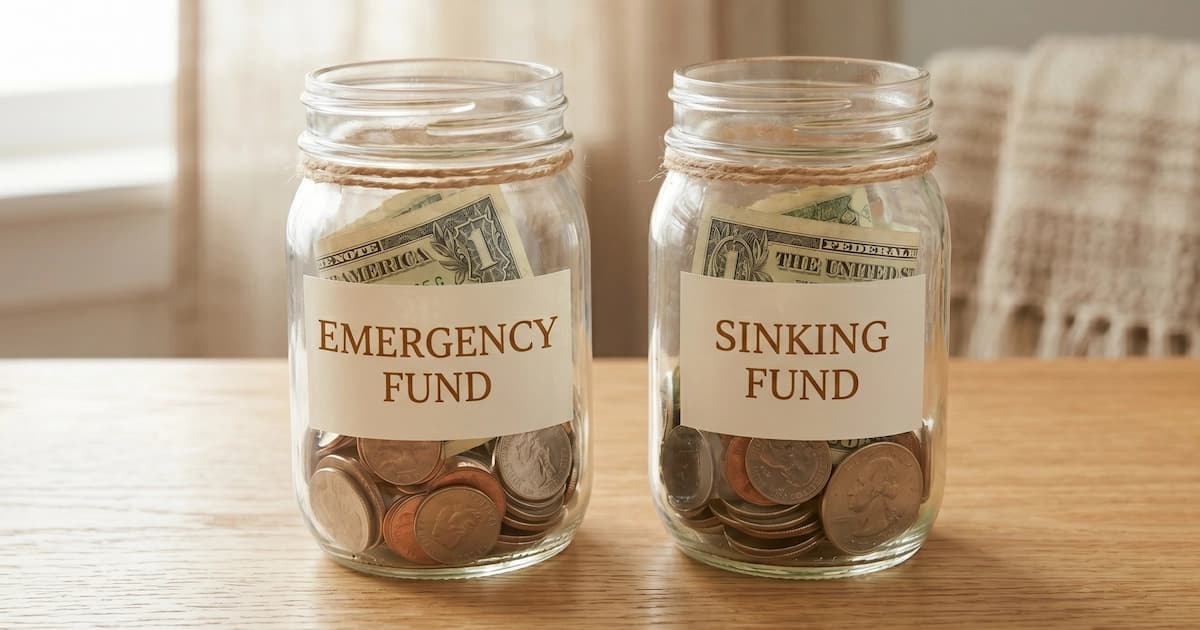
Before comparing anything, a word problem. In India, "sinking fund" means three unrelated things, and only one of them is a savings habit.
It is the line on your society maintenance bill. It is the reserve a company builds to redeem its debentures. And it is the household bucket every personal finance article means. Of nineteen pages we read across both regions, exactly one gestured at the ambiguity, and it never named the alternatives.
So this starts with which one you are looking at, then covers the boundary between the household version and an emergency fund, and what happens to that boundary when both sit in one account.
Which sinking fund do you mean?
Three unrelated things share the name, and the one you want depends on where you met the phrase.
| Sense | Where you meet it | What it is |
|---|---|---|
| Household | Personal finance articles | Money set aside on a schedule for a known future expense |
| Corporate | Debenture and bond documents | A reserve a company builds to repay debt at maturity |
| Housing society | Your monthly maintenance bill | A regulated levy for future structural work on the building |
The Indian search results are dominated by the corporate sense. Four of the twelve Indian pages we read discuss debentures and never mention household saving at all, and Wikipedia's article covers the corporate meaning alone. The society sense, which is how most urban Indians actually encounter the words, appeared on one page out of twelve, as a single heading.
The rest of this page is about the household sense, with the society levy covered near the end because it is genuinely regulated and almost nobody explains it.
What separates a sinking fund from an emergency fund?
The dividing line is whether the expense is known in advance. A sinking fund covers a cost you can name and date. An emergency fund covers one you cannot.
| Sinking fund | Emergency fund | |
|---|---|---|
| The expense | Known, with a rough date and amount | Unknown in timing, amount, or both |
| Balance over time | Rises then empties on schedule | Sits full, drops only on an event |
| Sized by | The target cost divided by months available | Your own essential monthly costs |
| Emptying it | Expected, and means it worked | A shock, and means it worked |
That last row is the one worth sitting with. A sinking fund hitting zero in December is the fund succeeding. An emergency fund hitting zero is a bad month.
What each fund is in its own right, including how sinking fund categories are chosen, belongs to the sinking fund explainer and the emergency fund explainer. This page is about the boundary between them.
What does sharing one account hide?
A single balance stops describing your protection the moment part of it is spoken for. Money mentally reserved for a known bill still leaves when that bill arrives, so the reserve available for a shock is the total minus every earmark.
Take a household holding ₹2,00,000 in one savings account, with essentials of ₹50,000 a month.
| Earmark | Amount |
|---|---|
| Diwali gifts and festival spending | ₹40,000 |
| School fees due in June | ₹60,000 |
| Annual motor insurance | ₹25,000 |
| Wedding season gifts | ₹30,000 |
| Total spoken for | ₹1,55,000 |
| Genuine emergency cover | ₹45,000 |
On the balance alone that account holds four months of essentials. The reserve that would actually meet a job loss is ₹45,000, which is under one month.
The same arithmetic in dollars, on a US expense calendar: $5,000 in one account, with $2,400 earmarked for a vacation, $800 for December gifts and $1,200 for an annual insurance premium, leaves $600 of real emergency buffer out of a balance that reads as $5,000.
Nothing changes about the money when it is separated. What changes is that the earmarks become visible before the shock rather than during it.
Is a car repair an emergency or a sinking fund expense?
Neither category settles it, which is why the clean examples every article uses avoid this case entirely. A vacation is obviously planned; a job loss is obviously not. The expenses people actually get stuck on sit in between.
A workable test skips the category and asks a single question: could you write the amount and the approximate date on a calendar today?
| Expense | Calendar test | Falls to |
|---|---|---|
| July holiday | Amount and month both known | Sinking |
| Annual insurance premium | Both known | Sinking |
| Routine service, tyres, battery near end of life | Predictable cycle, approximate cost | Sinking |
| Collision, or a failure well before end of life | Neither known | Emergency |
| Medical deductible or policy excess | Ceiling known, trigger unknown | Split, see below |
| A five-year-old laptop | Failure likely eventually, timing unknown | Emergency, until it is near replacement |
The medical row is the honest hard case. The maximum is knowable because the policy states it, while whether you use it in a given year is not. Treating the known ceiling as a sinking target and the timing as an emergency risk is one way people resolve it, and there is no consensus rule.
How much should the emergency side hold?
Almost every article states three to six months of expenses as settled fact, and the regulator most of them cite for it says no such thing.
The CFPB's emergency fund guide answers its own "how much do I need" heading by saying the amount depends on your situation, and pointing readers at the unexpected expenses they have actually had and what those cost. No months multiple appears.
For scale, the Federal Reserve's 2024 survey of household economic wellbeing found 55% of US adults had set aside money covering three months of expenses, up from 54% in 2023 and down from a peak of 59% in 2021. The same survey found 63% said they would cover a $400 emergency expense using cash, savings, or a card paid off at the next statement.
Working out your own number depends on income stability, dependants and fixed obligations, and that sits on its own page: how much emergency fund do I need. The path from zero to a funded reserve is in how to build an emergency fund.
What is the sinking fund on an Indian society bill?
It is a regulated corpus for future structural work, and it is a different line from the repairs and maintenance fund printed beside it.
Under Maharashtra's Model Bye-Laws for co-operative housing societies:
| Provision | What it says |
|---|---|
| Bye-law 13(c) | Sinking fund at a minimum of 0.25% per annum of each flat's construction cost, architect-certified, excluding the proportionate cost of land |
| Bye-law 13(a) | Repairs and maintenance fund at a minimum of 0.75% per annum on the same basis |
| Bye-law 14(c) | Use restricted to reconstruction, structural additions or alterations, or heavy repairs certified by the architect, on a general body resolution |
| Bye-law 15 | Funds invested per Section 70 of the Act, on a long-term basis |
| Bye-law 140 | A Sinking Fund Register is a mandatory book of account |
On a flat with an architect-certified construction cost of ₹40,00,000 excluding land, the minimum works out to ₹10,000 a year, or about ₹833 a month, against ₹30,000 a year for the repairs fund. Over twenty years, before any interest, that is ₹2,00,000 per flat sitting against future structural work.
Two qualifications matter. Co-operative societies are a state subject, so 0.25% is Maharashtra's model figure and other states set their own under their own acts. And the draft replacement bye-laws published on the same government portal keep 0.25% unchanged, so the number is not about to move in that state.
On tax, the GST Council's flyer on co-operative housing societies lists the sinking fund among charges that attract GST, sets an exemption of up to ₹7,500 per month per member for goods or services sourced for members' common use, and exempts societies with aggregate turnover up to ₹20 lakh in a financial year. One element is genuinely unsettled: the flyer's position that crossing ₹7,500 makes the whole bill taxable was challenged in the Madras High Court, and reporting on the case indicates a Division Bench stayed that portion pending review. Treat the flyer as the stated position and the point as live.
What this post deliberately does not cover
This covers the boundary between the two funds, what a shared account conceals, and the regulated Indian society levy. It does not tell anyone how to arrange their savings, name accounts or banks worth using, or decide what belongs in a reserve.
Several neighbouring subjects sit elsewhere on purpose. What a sinking fund is in its own right, and how categories get chosen, is in the sinking fund explainer. What an emergency fund is, is in its own explainer. Sizing the reserve is how much emergency fund, and building one from zero is how to build an emergency fund.
Three limits on what is here. The society figures are Maharashtra's model bye-laws, which do not govern other states. The GST treatment of society charges is under live challenge, so the position stated is the GST Council flyer's and not a settled rule. And the worked examples are illustrations built on stated assumptions, useful for seeing the shape of the arithmetic and nothing more.
Society levies, GST on maintenance charges and anything turning on your own finances belong with a qualified professional: a chartered accountant for the tax questions, and your society's own bye-laws for the levy, since those govern where the model only guides.
Frequently asked questions
Which sinking fund do you mean? Three unrelated things share the name, and the answer depends on where you met the phrase. In personal finance a sinking fund is money set aside on a schedule for a known future expense. In corporate finance it is a reserve a company builds to redeem debentures or repay debt at maturity, which is the sense most Indian search results return. On a co-operative housing society maintenance bill it is a regulated levy collected from flat owners for future structural work. The household sense and the society sense are the two an ordinary reader is most likely to encounter, and they behave nothing alike.
What happens if a sinking fund and an emergency fund share one account? The balance stops describing the protection. Money mentally reserved for a known bill is still spent when that bill arrives, so the reserve available for a genuine shock is the total minus every earmark. A household holding ₹2,00,000 with ₹40,000 for Diwali, ₹60,000 for June school fees, ₹25,000 for motor insurance and ₹30,000 for wedding gifts has ₹45,000 of real emergency cover. Against essentials of ₹50,000 a month, a balance that looks like four months of cover is under one.
Is a car repair an emergency or a sinking fund expense? Both, depending on which part of it you mean, and this is the case every explainer avoids. Vehicles need servicing, tyres and battery replacement on a predictable cycle, so that portion is knowable and can be funded on a schedule. A crash or a sudden failure of something not near end of life is not knowable. The workable test is not the category but the question of whether you could write the amount and the approximate date on a calendar today. Routine servicing passes that test; a collision does not.
What is the sinking fund on a society maintenance bill? It is a regulated corpus for future structural work, distinct from the repairs and maintenance fund on the same bill. Under Maharashtra's Model Bye-Laws for co-operative housing societies, bye-law 13(c) sets it at a minimum of 0.25% per annum of each flat's construction cost as certified by the society's architect, excluding the proportionate cost of land. Bye-law 14(c) restricts its use to reconstruction, structural additions or alterations, or heavy repairs certified by the architect, and only on a general body resolution. Co-operative societies are a state subject, so other states set their own rates under their own acts.
Does GST apply to society sinking fund contributions? The GST Council's own flyer on co-operative housing societies lists the sinking fund among charges that attract GST, alongside the repairs and maintenance fund and car parking charges. The flyer also sets out an exemption of up to ₹7,500 per month per member for goods or services sourced for members' common use, and states that a society whose aggregate turnover is up to ₹20 lakh in a financial year is exempt even where charges exceed ₹7,500. One point is contested: the flyer's position that crossing the threshold makes the entire bill taxable was challenged in the Madras High Court, and reporting on that case indicates a Division Bench stayed the relevant portion pending review.
How much should the emergency fund side hold? The three-to-six-month figure that nearly every article repeats is not what the regulator most of them cite actually says. The CFPB's emergency fund guide states that the amount depends on your situation and suggests looking at the unexpected expenses you have actually had and what they cost. It gives no months multiple. For scale on how households sit against it, the Federal Reserve's 2024 survey found 55% of US adults had set aside money covering three months of expenses, up from 54% in 2023 and down from a high of 59% in 2021. Picking your own number is a longer subject and has its own page.
Sources
-
Government of Maharashtra, Commissioner for Co-operation and Registrar of Co-operative Societies, Model Bye-Laws of Co-operative Housing Society (bye-law 13(c) sinking fund at a minimum of 0.25% per annum of architect-certified construction cost excluding land; 13(a) repairs fund at 0.75%; 14(c) restricted utilisation; 15 investment under Section 70; 140 the Sinking Fund Register) sahakarayukta.maharashtra.gov.in
-
GST Council, GST on Co-operative Housing Societies (the sinking fund listed among charges attracting GST, the ₹7,500 per member per month exemption, and the ₹20 lakh aggregate turnover carve-out) gstcouncil.gov.in
-
Consumer Financial Protection Bureau, An Essential Guide to Building an Emergency Fund (the answer to how much is needed, stated as depending on your situation, with no months multiple given) consumerfinance.gov
-
Board of Governors of the Federal Reserve System, Economic Well-Being of U.S. Households in 2024: Savings and Investments (55% with three months of expenses set aside, against 54% in 2023 and 59% in 2021; 63% covering a $400 expense with cash, savings or a card paid at the next statement) federalreserve.gov
-
Reporting on Greenwood Owners Association v. Union of India, on the challenge to the GST treatment of maintenance charges above ₹7,500 and the subsequent stay (cited as reporting, since the judgment text was not read directly) taxguru.in



You might also like

A sinking fund is money set aside monthly for a known future expense. The missing layer between a budget and an emergency fund, explained plainly.
9 min read

An emergency fund is savings held apart from goals and investments. What counts as an emergency, and why other money decisions sit on top of it.
10 min read

No regulator says three to six months. The RBI says two. Work out your own from essential expenses and how long your income could stop.
13 min read