How Does Debt Consolidation Work? The Process and Costs

By Tapabrata Biswas · Updated July 19, 2026 · 15 min read
Researched with AI assistance, reviewed and edited by Tapabrata Biswas.
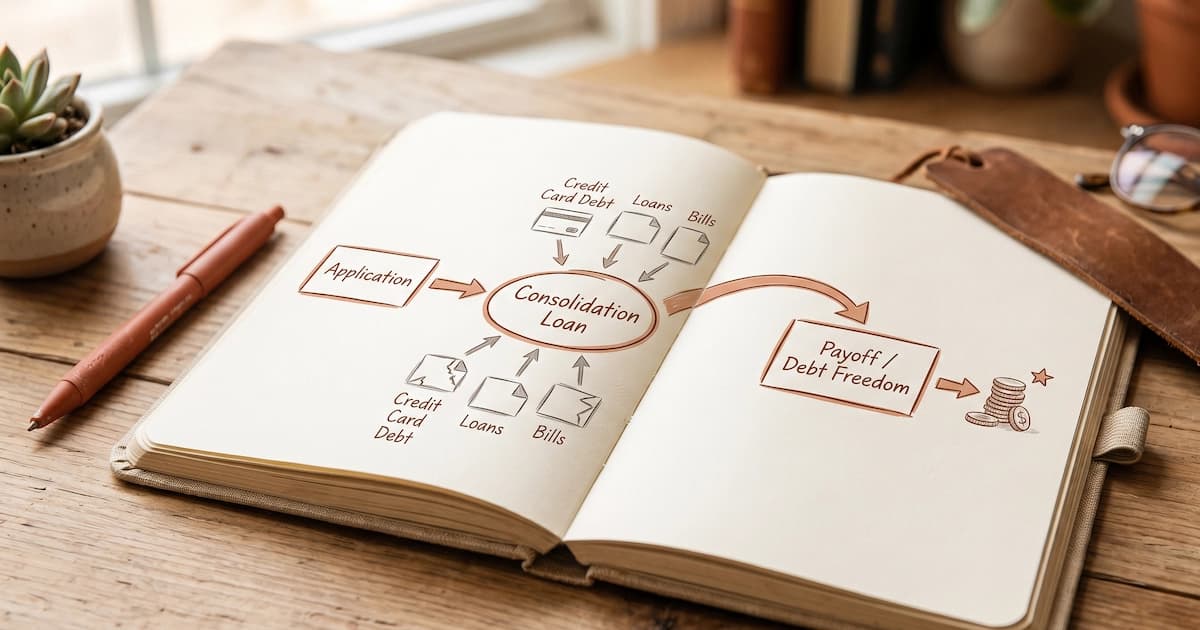
American credit card accounts that carried interest were charged 22.15% in May 2026. A 24-month personal loan from the same commercial banks cost 11.86%. Both figures come from the Federal Reserve's G.19 release published on 8 July 2026, and the gap between them, a little over ten percentage points, is the entire mechanical case for consolidating.
Whether the gap survives contact with fees, tenure and behaviour is another matter, and that's what this post is about.
One warning first, because it's the most expensive assumption an Indian reader can carry over from American advice: the US balance-transfer product does not exist in India. Of seventeen US pages we read on this topic, not one mentions India. Of the Indian lender pages, none explains why the American playbook doesn't transfer. The structural difference is covered in full below.
What follows is the procedure: the steps and how long each really takes, what qualification actually looks like when you read what lenders disclose, what consolidating does to a credit score and in what order, whether the arithmetic survives the fees, and the red flags that mean walking away. For whether consolidating is the right move at all, and for the comparison against settlement and debt management plans, our companion piece on what a debt consolidation loan is covers the decision.
How does debt consolidation actually work?
Debt consolidation replaces several existing debts with one new debt, so that multiple payments at multiple rates become a single payment at one rate. The old balances are cleared in full. Nothing is forgiven, and nothing is written off.
That last point separates it from the product it's most often confused with. Consolidation repays what's owed; settlement tries to get part of it excused. They have opposite effects on a credit file, and the companion post sets out the full comparison.
The mechanism has one requirement. The new rate, once fees are included, has to be low enough against the blended rate of the debts being replaced for the exercise to be worth doing. Where that threshold sits, and how to calculate the blended rate, belongs to the decision post. This one assumes the decision is made and follows what happens next.
What are the steps, and how long does each take?
The process runs in five stages, and the money moves faster than most people expect while the payoff stage is slower.
| Stage | What happens | Realistic timing |
|---|---|---|
| 1. Gather | List every balance, rate, and minimum payment | An evening |
| 2. Shop | Compare offers, ideally pre-qualifying with a soft check | 1 to 3 days |
| 3. Apply | One formal application, which triggers a hard inquiry | Same day |
| 4. Fund | Lender disburses | 1 to 3 working days in India; often within 2 business days at US online lenders |
| 5. Pay off | Old balances cleared, single payment begins | A further few working days |
Two details in stage four decide how smoothly the rest goes.
Ask whether the lender pays your creditors directly. Some disburse straight to the old accounts; others send the money to the borrower's bank account and trust them to forward it. The second route is where consolidations quietly fail, because the funds land in a spending account and get partly spent. Direct-to-creditor disbursal removes that failure mode entirely.
Pre-qualifying is not applying. Most lenders offer a pre-qualification that uses a soft credit check and doesn't affect the score, which is what makes shopping several offers cheap. The hard inquiry comes only at formal application. Anyone comparing offers should confirm which check a lender is running before submitting.
What does consolidating do to your credit score, and when?
The effect people brace for is the hard inquiry, and the effect that actually catches them is closing the paid-off cards.
Four things move, in this order:
The hard inquiry lands at application. It's a small, temporary effect and it's the one every article mentions.
Average account age falls when a new loan opens, because a fresh account drags down the average age of the file.
Utilisation drops sharply once the cards are paid to zero. This is the beneficial one, and on most files it's the largest single movement.
Then, if the cards get closed, utilisation climbs back. This is the trap. Utilisation is balances measured against total available credit. Close a paid-off card and its limit leaves the denominator, so the ratio can end up higher than before the consolidation despite the balances being gone. Keeping the cards open and unused preserves the limits and the account age at the same time.
Only three of the seventeen pages we read explain that last mechanism. Most stop at "your score may dip temporarily," which describes the smallest of the four effects and omits the largest.
On numbers: neither FICO nor the Indian bureaus publish exact point values for any of these movements, and the weightings are proprietary. Articles quoting precise figures, including the earlier version of this page, are extrapolating. What can be said with confidence is the direction of each effect and their order, which is what determines whether a consolidation helps a credit file or hurts it. Our credit utilisation explainer covers how the ratio itself is calculated.
Does the arithmetic actually survive the fees?
The rate gap is real, and processing fees are what decide whether it reaches the borrower.
Take the verified US figures. A $18,000 card balance carried at the 22.15% assessed-interest rate accrues roughly $3,990 in a year if the balance stays flat. The same $18,000 on a 24-month personal loan at 11.86% costs about $2,270 in total interest across the full two years, because the balance amortises down while the card balance sits still.
That comparison is deliberately not apples to apples, and the difference matters. The card figure is a year of interest on a balance that never falls. The loan figure is all the interest across a loan that fully retires. Card minimums are set low enough that balances often do stay near flat, which is precisely why the two shapes diverge so sharply.
Now the fee. An origination or processing fee is charged on the amount borrowed, so a 2% fee on $18,000 is $360, added either to the principal or deducted from the disbursal. Against roughly $1,720 of interest saved in this illustration, a 2% fee absorbs about a fifth of the benefit. At 6% it absorbs well over half. The fee is not a footnote.
In India there is a further layer, because GST at 18% applies to the processing fee. A 2% fee on ₹5,00,000 is ₹10,000 on the tariff sheet and ₹11,800 once the tax lands. The debt consolidation calculator runs this arithmetic on your own numbers, including what your current lenders charge to close early, and tells you when the answer comes out negative.
The Indian picture uses the same logic with different inputs. HDFC Bank and ICICI Bank both advertise personal loans starting at 9.99% per annum, retrieved 19 July 2026, with ICICI stating a processing fee of up to 2% of the loan amount plus applicable taxes. Both figures are advertised floors, never ranges: none of the Indian bank pages we could reach publishes an upper bound or an effective-from date, so the honest reading is that 9.99% is the best case for the strongest applicants.
Wells Fargo is unusually direct about this on the US side, disclosing that at least 10% of applicants approved for its terms qualified for the lowest rate, on a range of 6.74% to 26.74% APR as of 2 April 2026. Read that sentence carefully and it says the headline number is a minority outcome.
Why doesn't the US balance-transfer playbook work in India?
Indian balance transfer offers run for weeks or months where American ones run for the better part of two years, and several charge interest from the start.
| United States | India | |
|---|---|---|
| Typical interest-free window | 12 to 21 months | About 60 days to 12 months |
| Rate during the window | 0% | Often about 0.99% per month |
| Transfer fee | 3% to 5% | 1% to 3%, plus 18% GST on the fee |
| Transfer cap | Usually the full credit limit | Commonly around 75% of the limit |
The specifics, from 2026 card listings: SBI Card advertises 0% for roughly 60 days, after which a monthly rate applies. Standard Chartered runs its offer at about 0.99% per month, which is a reduced rate and not a free one. HDFC structures its version as Balance Transfer on EMI, converting the balance into instalments over nine to forty-eight months at a lower rate. ICICI offers an introductory 0% period of up to twelve months, the closest thing to the American shape.
A 60-day window is not a repayment plan. It's a grace period. Clearing a meaningful card balance inside two months requires the cash to have been available anyway, which is why the Indian market resolves this differently: the personal loan is the consolidation instrument, and the balance transfer is a short-term bridge.
RBI's own lending data shows that resolution happening at scale. In the Sectoral Deployment of Bank Credit release for May 2026, published 30 June 2026, personal loans grew 15.4% year on year against 11.1% a year earlier, while credit card outstandings decelerated. Card balances moving onto personal loans is exactly the pattern those two numbers describe.
What should make you walk away?
A company that asks for money before it has done anything is the clearest signal, and in the US it's also breaking a rule.
The FTC's 2010 amendment to the Telemarketing Sales Rule prohibits for-profit companies selling debt relief services by telephone from charging a fee before they actually settle or reduce a consumer's debt. Its consumer guidance puts it plainly: only scammers try to collect fees before settling any debts or entering someone into a debt management plan.
Three more process-stage warnings, each from a regulator:
A lower monthly payment can mean paying more. The CFPB notes that the reduction often comes from a longer repayment period, in which case the total cost rises even as the monthly figure falls. Tenure is the variable to check whenever a payment looks unexpectedly comfortable.
Home equity consolidation moves the risk onto the house. The CFPB's warning is direct: fail to repay and the home can be lost to foreclosure. Converting unsecured card debt into secured debt against a property changes what failure costs.
Being told to stop paying creditors is a red flag, not a strategy. The FTC records that settlement programmes often encourage exactly this, which grows late fees and penalties, damages credit, and leaves the borrower exposed to collection efforts and lawsuits while they wait.
The CFPB's summary of consolidation itself is worth sitting with, because it's blunter than most coverage: taking on new debt to pay off old debt "may just be kicking the can down the road," and many people don't succeed "unless they lower their spending."
What this post deliberately does not cover
This is the procedure. It doesn't recommend consolidating, a lender, or a product to anyone, and the worked figures exist to show how the arithmetic behaves, never to argue for a course of action.
The decision itself sits in the companion post: what a consolidation loan is, the three product types, how to calculate the blended rate of your existing debts and how far the new rate needs to sit below it, and the full comparison against debt settlement and debt management plans. Payoff ordering without new borrowing is a different approach entirely, covered in debt snowball versus avalanche. The instrument most often used to consolidate has its own explainer in what a personal loan is, and card interest mechanics live in how credit card interest works.
Three limits on the numbers. Indian bank rates in this post are advertised starting rates retrieved on 19 July 2026, not ranges, because no Indian bank page we could reach publishes an upper bound or an effective date. The Indian balance-transfer terms come from 2026 card listings, since several issuers' own rate documents blocked retrieval. And no credit-score point values appear anywhere in this post, because the bureaus don't publish them.
Debt decisions turn on income, security of that income, and what caused the debt, none of which an article can see. A qualified financial adviser or a nonprofit credit counselling agency is the right place for advice on a specific situation.
Frequently asked questions
How long does debt consolidation take from application to payoff? Days, not weeks, for the money, and the timing splits into two stages people tend to merge. The application-to-funding stage is the fast one: Indian lenders commonly advertise disbursal in one to three working days, and US online lenders often fund within two business days, with Citi stating funding in two business days for existing customers. The second stage is paying off the old accounts, which takes a further few working days and depends on whether the lender pays creditors directly or routes the money through the borrower's account. Direct-to-creditor disbursal removes the risk of the money being spent on something else, so it is worth asking which model a lender uses before signing.
Does debt consolidation hurt your credit score? Two separate things happen and most explanations only describe the first. The application triggers a hard inquiry, which is a small and temporary effect. The larger effect comes later and catches people out: paying off credit cards and then closing them reduces total available credit, so the utilisation ratio can rise even though the balances went to zero. Keeping the paid-off cards open and unused avoids that, because the limits stay in the calculation. A third factor is account age, since a new loan lowers the average age of accounts. Neither FICO nor the Indian bureaus publish exact point values for any of these, so treat any article quoting a precise figure with caution.
Do balance transfer cards work the same way in India? No, and assuming they do is the most expensive mistake an Indian reader can make with US advice. The American model is roughly 0% interest for twelve to twenty-one months against a 3% to 5% transfer fee. Indian offers are structurally different: SBI Card advertises 0% for about 60 days before a monthly rate applies, Standard Chartered's offer runs at roughly 0.99% per month, and HDFC's Balance Transfer on EMI converts the balance into an instalment plan over nine to forty-eight months at a reduced rate. Fees generally run 1% to 3% plus 18% GST on the fee, and transfers are commonly capped near 75% of the credit limit. That much shorter runway is why Indian borrowers more often consolidate with a personal loan.
What credit score do you need for a debt consolidation loan? Lenders publish starting rates, not approval cutoffs, so any single threshold quoted online is a rule of thumb at best. What lenders do disclose is that advertised rates go to the strongest applicants: Wells Fargo states plainly that at least 10% of applicants approved for its terms qualified for the lowest rate, on a range running 6.74% to 26.74% APR as of 2 April 2026. In India, HDFC Bank and ICICI Bank both advertise personal loans starting at 9.99% per annum, retrieved 19 July 2026, with ICICI stating a processing fee of up to 2% of the loan amount plus applicable taxes. The practical reading is that the headline rate is the best case, not the expected case.
How is debt consolidation different from debt settlement? Consolidation replaces several debts with one new debt and repays the full amount. Settlement tries to get part of the debt forgiven, and the FTC names five distinct harms attached to it: people frequently drop out having already paid fees, the programmes often encourage stopping payments to creditors which damages credit, borrowers can be sued and face wage garnishment or a lien while waiting, creditors have no obligation to negotiate at all, and any forgiven amount may count as taxable income. The FTC also prohibits a for-profit settlement company from collecting fees before it settles a debt, under its 2010 amendment to the Telemarketing Sales Rule. A company asking for money upfront is therefore breaking that rule.
What does the CFPB say about consolidating credit card debt? It is blunter than most summaries suggest. The CFPB warns that taking on new debt to pay off old debt may just be kicking the can down the road, that many people do not succeed in paying off debt by borrowing more unless they lower their spending, and that the loans taken out to consolidate may end up costing more in fees and rising interest rates than the original payments would have. It also flags that a lower monthly payment often comes from a longer repayment period, which means paying more overall, and that consolidating into a home equity loan puts the house at risk if payments stop.
Sources
-
Board of Governors of the Federal Reserve System, G.19 Consumer Credit, released 8 July 2026, data for May 2026 (24-month personal loans at 11.86%, credit card accounts assessed interest at 22.15%) federalreserve.gov
-
Reserve Bank of India, Sectoral Deployment of Bank Credit, May 2026, released 30 June 2026 (personal loans growing 15.4% year on year against 11.1%, with credit card outstandings decelerating) rbi.org.in
-
Consumer Financial Protection Bureau, What do I need to know about consolidating my credit card debt?, last reviewed 28 August 2023 (the kicking-the-can warning, the spending-reduction condition, the longer-term caution and the home-equity foreclosure risk) consumerfinance.gov
-
Federal Trade Commission, How to get out of debt (the five named harms of debt settlement, and that only scammers collect fees before settling) consumer.ftc.gov
-
Federal Trade Commission, Debt relief and credit repair scams (the 2010 Telemarketing Sales Rule amendment prohibiting advance fees) ftc.gov
-
Wells Fargo, Debt consolidation loans (6.74% to 26.74% APR effective 2 April 2026, and the disclosure that at least 10% of approved applicants qualified for the lowest rate) wellsfargo.com
-
Bank rate pages retrieved 19 July 2026, each publishing an advertised starting rate without an effective date: HDFC Bank, ICICI Bank

You might also like

The three forms debt consolidation takes in India and the US, and the conditions under which it saves money rather than just rearranging it.
11 min read
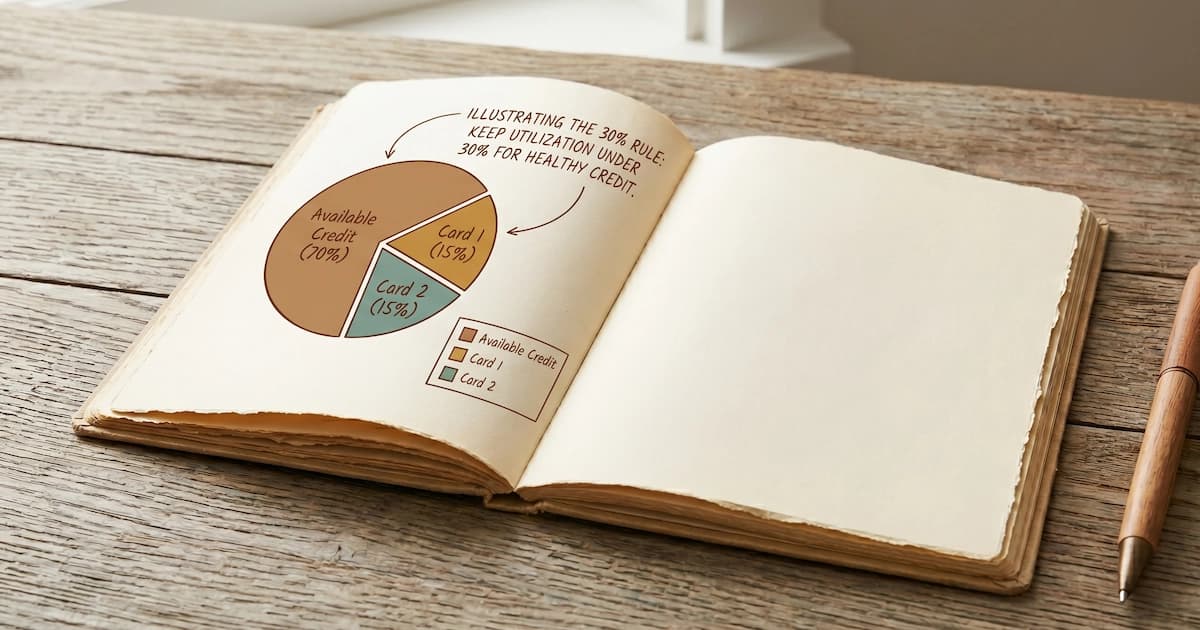
TransUnion CIBIL calls 30% a healthy ratio but sets no official cut-off, and FICO publishes none either. What the data shows, and why top scores sit under 10%.
14 min read

Credit card interest is charged daily on your average daily balance once you carry a balance. The real math, grace periods, and the minimum trap, in ₹ and $.
13 min read