How Student Loan Interest Works: Accrual and Real Cost

By Tapabrata Biswas · Updated September 2, 2026 · 11 min read
Written and fact-checked by Tapabrata Biswas. How I write
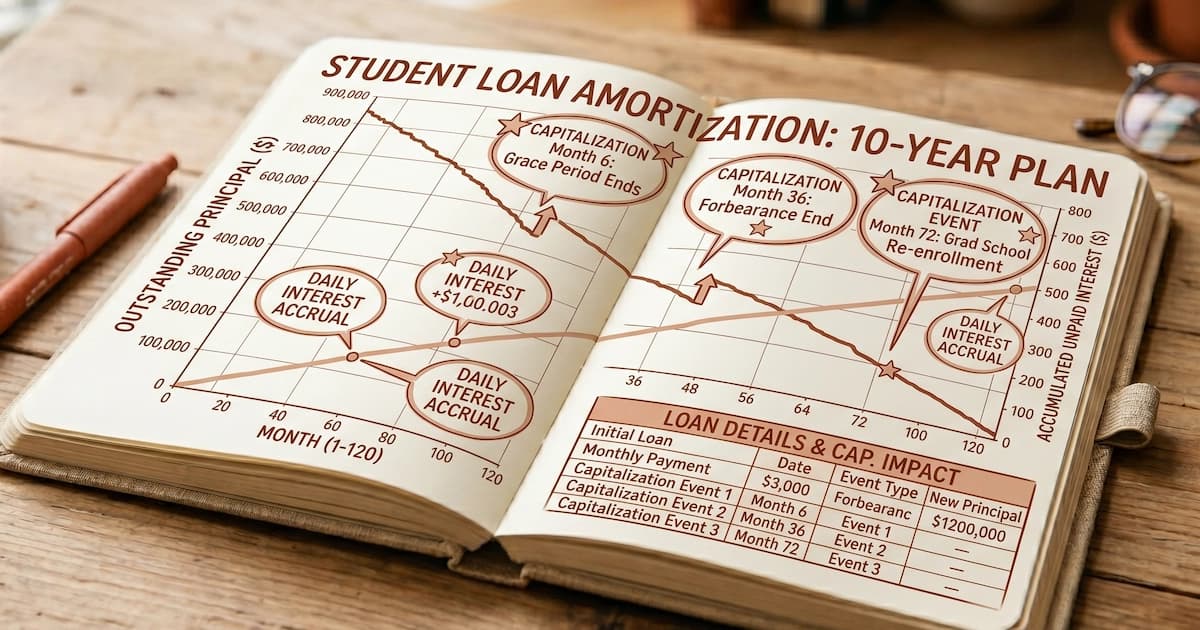
A 2024-25 US federal Direct Unsubsidised loan disbursed at $30,000 carries an interest rate of 6.53%, set by the May 2024 Treasury auction and fixed for the life of the loan. The same loan in India, a ₹25 lakh education loan at SBI for a premier engineering institute, carries an interest rate of around 10% under the Scholar scheme, also fixed at the time of disbursement. Same purpose (financing higher education), wildly different cost structures, and identical confusion about what the rate actually means in monthly terms.
This post walks through how student loan interest is calculated in both jurisdictions, what the published rates mean in real money, where capitalisation enters the picture, and the few mechanical levers borrowers can actually pull to reduce total cost.
What is student loan interest
Student loan interest is the cost of borrowing the principal: calculated as a percentage of the outstanding balance and accruing over time. Unlike credit card interest, which compounds daily and is covered in our credit card interest explainer, most student loans use a simpler daily simple interest formula or a standard reducing-balance EMI structure.
The mechanic that distinguishes student loan interest from most other consumer credit is the deferral periods built into the loan structure. Interest accrues while the borrower is in school, during grace periods, and through any deferments, but most borrowers do not pay it until repayment begins. What happens to that accrued interest at the deferral-to-repayment transition is where capitalisation enters and where the published rate quietly understates the true cost.
How US federal student loan interest is calculated
US federal student loans use a daily simple interest formula defined in 34 CFR 685.202. The annual rate is divided by 365 to produce a daily periodic rate, multiplied by the outstanding principal, and accumulated each day. The formula is simple, no compounding within a payment cycle, but the daily accrual matters because every day the balance is higher costs the borrower more.
A worked example using the 2024-25 Direct Subsidised undergraduate rate of 6.53%, published by Federal Student Aid:
- Principal: $30,000
- Annual rate: 6.53%
- Daily rate: 6.53% ÷ 365 = 0.0179%
- Daily interest: $30,000 × 0.0179% = $5.37
- Monthly interest (30 days): roughly $161
- First-year interest: roughly $1,959
Treasury auction sets new rates each May for loans disbursed from July through the following June. The rate that applies to a specific loan is locked at disbursement and does not change for the life of that loan, even if Treasury auction sets a different rate the following year.
Per Federal Student Aid's 2024 disclosure, the 2024-25 rates are:
| Loan type | Borrower | Fixed rate (2024-25) |
|---|---|---|
| Direct Subsidised | Undergraduate | 6.53% |
| Direct Unsubsidised | Undergraduate | 6.53% |
| Direct Unsubsidised | Graduate/professional | 8.08% |
| Direct PLUS | Graduate/professional, parents | 9.08% |
Rates are higher in 2024-25 than in any year since 2008, reflecting elevated Treasury yields throughout 2023-24. A graduate borrower at 8.08% pays roughly 24% more interest over a 10-year repayment period than the same loan would have cost at the 4.30% rate of 2020-21.
How Indian education loan interest is calculated
Indian education loans use a different mechanic. During the moratorium (course duration plus 6 to 12 months) simple interest accrues on whatever has been disbursed, and if you don't service it, the whole accrued amount joins the principal once, at the point repayment starts. The Indian Banks' Association model scheme specifies simple interest during the repayment holiday and says the accrued interest is to be added to the principal, and SBI's own repayment page describes the same treatment. It capitalises once, not annually. Once EMIs begin the loan switches to standard reducing-balance amortisation, the same math used for home loans.
A worked example for a ₹10 lakh loan at SBI's Education Loan Scholar rate of approximately 10% over a four-year B.Tech with a one-year moratorium:
- Principal disbursed (assume full ₹10 lakh upfront): ₹10,00,000
- Monthly interest at 10%: ₹10,00,000 × (10% ÷ 12) = ₹8,333
- Five years of moratorium interest (60 months) as simple interest: ₹5,00,000
- Principal at start of repayment, once that is capitalised: ₹15,00,000
- Standard 10-year EMI on ₹15,00,000 at 10%: ₹19,823/month
Indian banks publish education loan rates as a markup over the Repo Linked Lending Rate (RLLR) or the Marginal Cost of Funds-based Lending Rate (MCLR). The RBI policy repo rate was 5.25% when this page was last checked on 21 July 2026, having come down from the 6.50% it held between February 2023 and early 2025. Because the final rate is that benchmark plus a lender-specific markup, published education loan rates move with the repo rate but not by the same amount, and the markup differs by lender and by scheme. How that benchmark and markup fit together is covered in what an interest rate is.
| Lender / scheme (2024) | Rate range | Notes |
|---|---|---|
| SBI Education Loan Scholar (premier institutes) | ~10% | IITs, IIMs, NITs, AIIMS list |
| SBI Education Loan (general) | 10.5-11.5% | All other recognised institutions |
| Bank of Baroda Baroda Vidya | 9.7-11.7% | Public sector pricing |
| Punjab National Bank Saraswati | 10.7-11.95% | Public sector pricing |
| HDFC Credila | 10.5-14% | Private NBFC lender |
| Axis Bank Education Loan | 13.7-15.2% | Private bank pricing |
Female borrowers receive a 0.5% concession at most public sector banks. Loans backed by tangible collateral (property, fixed deposits) typically carry rates 0.5-1% lower than unsecured loans. The interest rate gap between secured and unsecured education loans is the single most cost-relevant variable for Indian borrowers with collateral options.
The moratorium is the part almost every education loan EMI calculator skips. Our education loan moratorium calculator builds the interest through the course and grace period, folds it into the principal once, and prices the EMI from there, with the women's concession included.
Capitalisation: the hidden cost on both sides
Capitalisation is the same mechanic in both jurisdictions: accrued unpaid interest gets folded into principal, and future interest is calculated on the new larger balance.
On US federal loans, capitalisation events include:
- End of grace period on unsubsidised loans (six months after leaving school)
- End of any deferment period
- End of forbearance
- Voluntary exit from an income-driven repayment plan (in some cases)
A 2023 regulatory change under the Department of Education's final rule on borrower defence and related matters eliminated capitalisation at the end of grace period for new loans first disbursed on or after 1 July 2023, meaning the unpaid grace-period interest stays separate from principal but still must be paid. This change affects the loan's amortisation but not the total interest owed.
On Indian education loans, capitalisation is built into the moratorium structure, and it lands in one go rather than every year. On the example above, five years of unserviced interest turns a ₹10 lakh loan into a ₹15 lakh one before the first EMI falls due, which is 50% larger. Loans released in stages across the course accrue less than that, because interest runs only on what has actually been disbursed.
Servicing that interest has a tax consequence as well as a cost one, because the eight-year window for the Section 80E deduction starts in the year you first pay interest, not the year the EMI begins.
Avoiding capitalisation through interest-only payments during deferral is the highest-leverage cost-reduction lever available. On the ₹10 lakh example above, paying ₹8,333 a month through the moratorium keeps the entire ₹5,00,000 out of the principal and holds the EMI at ₹13,215 instead of ₹19,823. That's ₹6,608 a month across 120 EMIs, or ₹7,92,904 in lifetime EMI savings, for ₹5,00,000 paid during the moratorium. A net gain of about ₹2.93 lakh.
Subsidised vs unsubsidised: the only US loan distinction that pays you back
The federal Direct Subsidised loan is the only US student loan where the government pays the interest during specific deferral periods (in-school enrolment, grace period, authorised deferment). The same loan with the same 6.53% rate as an Unsubsidised loan costs measurably less because the borrower never owes the deferred interest at all.
Eligibility is needs-based, determined by the FAFSA's calculated Student Aid Index. Undergraduate students from low- and middle-income families qualify; graduate students do not, the Direct Subsidised loan was eliminated for graduate borrowers in 2012. Annual subsidised loan limits range from $3,500 (first-year) to $5,500 (third-year and beyond), with a $23,000 aggregate cap.
The Indian equivalent, the CSIS scheme, covers moratorium-period interest only, only for loans up to ₹7.5 lakh, and only for borrowers from families earning under ₹4.5 lakh annually. The eligibility threshold excludes most middle-class borrowers entirely.
What experts say
Federal Student Aid's interest rate disclosure page is the authoritative source for current US federal rates and the Treasury auction methodology. Their interest accrual calculator confirms the daily simple interest formula and the rounding conventions used by federal servicers.
The Reserve Bank of India's Master Direction on Lending Rates sets the framework under which Indian banks price education loans, including the requirement that retail loans (including education loans) be benchmarked to an external rate: most commonly the repo rate. The directive is the reason most Indian education loan rates moved up in lockstep when RBI raised the repo rate from 4.0% to 6.5% during 2022-23.
The Consumer Financial Protection Bureau's annual student loan ombudsman report has identified capitalisation surprises and rate confusion (multiple rates on a single account) as the top borrower complaints across multiple reporting cycles. The pattern reflects how poorly the daily accrual mechanic is communicated by servicers: most borrowers find out about it only when the first repayment statement shows a balance higher than the disbursed amount. For a deeper foundation on how interest charges scale, see the related APR vs interest rate explainer and compound interest explainer. To model your specific student loan EMI at three candidate tenures, our loan calculator handles the math directly.
Frequently asked questions
Is student loan interest calculated daily or monthly? US federal student loans use a daily simple interest formula. The annual rate is divided by 365 to get a daily periodic rate, applied to each day's outstanding principal, and accumulated until the next payment posts. A $30,000 loan at 6.53% accrues roughly $5.37 in interest every day. Most Indian education loans use monthly compounding during the moratorium, then convert to standard reducing-balance EMI calculations during repayment: different math, similar end result.
What are current US federal student loan interest rates? For loans first disbursed between 1 July 2024 and 30 June 2025: Direct Subsidised and Unsubsidised undergraduate at 6.53%, Direct Unsubsidised graduate at 8.08%, and Direct PLUS (graduate and parent) at 9.08%. Rates are set annually by Treasury auction in May and published by Federal Student Aid. Each year's disbursement carries its own fixed rate for the life of the loan: borrowers with multiple years of loans often have multiple different interest rates on a single account.
What are current Indian education loan interest rates? Indian education loan rates range from roughly 8.5% to 13% as of late 2024, depending on bank, course, institution tier, and collateral. SBI's Education Loan Scholar scheme charges around 10% for premier institutes (IITs, IIMs, and similar). Public sector banks generally offer lower rates than private banks. Female borrowers receive a 0.5% concession at most public sector banks. Loans backed by collateral typically carry rates 0.5-1% lower than unsecured loans.
What is interest capitalisation and when does it happen? Capitalisation is when accrued unpaid interest gets added to the loan principal, so future interest is calculated on the larger balance. On US federal loans, capitalisation events include the end of the grace period (for unsubsidised loans), the end of any deferment or forbearance period, and the change of repayment plan in some cases. On Indian education loans, the entire moratorium period's accrued interest capitalises when EMIs begin. Avoiding capitalisation by making interest-only payments during deferral is the single most effective interest-reduction strategy.
In summary
Student loan interest is mechanically simpler than credit card interest, daily simple accrual on the US side, monthly accrual converting to reducing-balance EMI on the Indian side, but the deferral periods give the headline rate a lot of room to understate the real cost. A 6.53% US loan or a 10% Indian loan, accruing untouched through years of in-school deferral and grace, ends up considerably more expensive than the published rate suggests. The borrowers who reduce that cost meaningfully are the ones who treat the deferral period as the start of repayment, even at interest-only payments.
Sources
- Federal Student Aid, Interest Rates and Fees, 2024-25 federal student loan rates set by May 2024 Treasury auction
- Reserve Bank of India, Master Direction on Interest Rate on Advances, external benchmark and lending rate framework for Indian retail loans including education loans
- Indian Banks' Association, Model Education Loan Scheme, standard Indian education loan structure and moratorium provisions
- Consumer Financial Protection Bureau, Student Loan Ombudsman Report, borrower complaint patterns and capitalisation issues
- Federal Register, Department of Education Final Rule, November 2022, elimination of capitalisation at end of grace for loans disbursed on or after 1 July 2023



You might also like
Indian floating-rate bank loans must reset at least once every three months under an RBI rule. What sets your rate, and which benchmark it is tied to.
13 min read

APR is the rate plus fees, but the rules exclude a specific list. What India's Key Facts Statement requires, and why credit cards sit outside it.
14 min read

The formula, worked rupee examples, and why compounding daily rather than yearly is worth far less than most people assume.
11 min read